
The Agentic Operating Model: Turning Governance into Operating Change
How organisations must redesign work, responsibility, funding, and management rhythms when AI agents begin to act.
The Agentic AI Economy | Article 6 of 8
Horizon SPI Executive Intelligence Series
By Steven Kiss, MBA | July 2026
Executive Summary
Agentic AI is entering organisations whose workflows, roles, and management systems were designed on the assumption that only people could act.
The first five articles in the Horizon SPI Executive Intelligence Series followed agentic AI from capability and architecture through platforms, enterprise deployment, and governance. Article 5 established the foundations organisations need around agents: decision architecture, access controls, security, monitoring, accountability, and meaningful human oversight.
Article 6 moves inside those foundations. It asks what must change in the organisation when agents begin participating directly in decisions, coordination, and execution.
Governance can define what an agent is allowed to do. It can restrict access, assign accountability, require monitoring, and establish where human judgment must remain. Those decisions become operational only when they are reflected in workflows, roles, budgets, performance measures, and recurring management routines.
That is the operating-model challenge.
An agent placed inside an existing process may save time at one step. It may also create new handoffs, move practical authority to places the organisation cannot see, or expose weaknesses that were manageable when people moved the work manually. The technology may be ready to act before the organisation is ready to absorb what that action changes.
Building an agent is one challenge. Building an operating model that can use agents safely, consistently, and accountably is another.
From Governance Architecture to Operating Reality
The operating-model gap is now visible in the research. IBM’s Institute for Business Value reported that 78% of surveyed C-suite executives believed achieving the maximum benefit from agentic AI would require a new operating model. Deloitte’s 2026 enterprise AI research found that 48% of respondents had introduced AI without redesigning the workflows or roles around it. Only 12% reported redesign at scale with a new operating model behind it.
These findings draw on different evidence bases: IBM addresses agentic AI, while Deloitte covers broader AI adoption. That distinction matters. The gap between technology deployment and operating design predates agents. Agentic AI intensifies it because agents can initiate, coordinate, and complete work rather than produce information for someone else to use.
For a short period, leadership teams could treat agents as an innovation stream. They could fund proofs of concept, observe early results, and postpone the organisational questions until the technology became more dependable. That separation becomes harder to maintain once agents take part in multistep workflows, move between systems, or influence decisions that carry customer, financial, legal, or operational consequences.
At that point, the deployment is no longer contained inside the technology team. It affects how business units operate, how managers supervise work, how performance is measured, and where responsibility sits when an outcome is wrong.
- Executive observation: Governance defines the boundaries around agents. The operating model determines whether those boundaries survive contact with everyday work.
Why Existing Operating Models Struggle with Agents
Most enterprise operating models were built around a familiar division of responsibility: people perform the work; software records, routes, calculates, or supports it; and managers supervise the people. Decisions move through approval chains, while accountability follows reporting lines and assigned roles.
Agentic AI does not fit neatly into that arrangement.
An agent may gather information, interpret instructions, compare options, initiate a transaction, call another system, monitor a result, and decide what to do next. It may perform one of those activities or several of them across a single workflow. Its actions may cross departmental boundaries even when no role in the organisational chart owns the full path.
The pressure appears first in the gap between tasks and workflows. An agent may be introduced at one step while creating consequences across the wider process. Authority can also move without appearing to move. A formal policy may still state that a manager owns a decision, while the recommendation, prioritisation, or initiation of that decision has shifted to an agent. The manager remains accountable but may have less visibility into how the work arrived.
Agents also complicate the relationship between technical ownership and operating ownership. A platform team may configure the agent, security may control its access, and a vendor may provide the underlying system. The business function still experiences the customer, financial, legal, or operational consequence.
The technology may have several owners. The outcome still needs one.
Traditional transformation programs have long wrestled with process redesign, system implementation, and change management. Agentic AI sharpens the question: how should work be organised when systems can participate directly in execution rather than only support the people performing it?
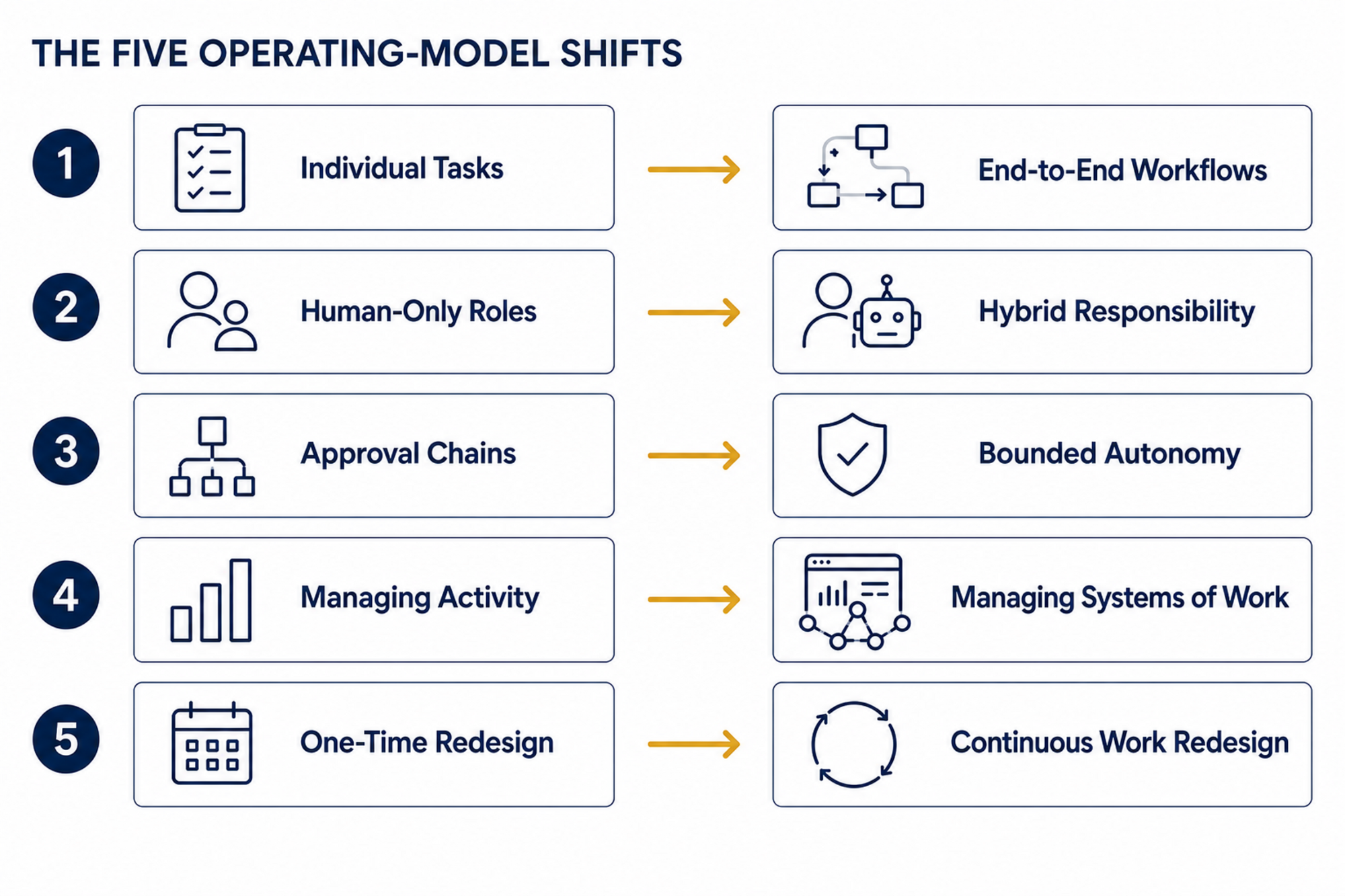
Diagram 1: The Five Operating-Model Shifts shows how agentic AI moves the design question from isolated tasks and approval chains toward workflows, hybrid responsibility, bounded autonomy, systems of work, and continuous redesign.
Five Operating-Model Shifts
Organisations scaling agentic AI will need to manage five related shifts. Horizon SPI treats them as design questions, not predictions that every process will become autonomous. They matter more as agents take on a larger role in operational work.
Shift 1: From Individual Tasks to End-to-End Workflows
The first shift is in the unit of design.
Many AI programs begin with tasks because tasks are easier to identify and measure. Draft this document. Check this record. Categorise this request. Compare these options. Produce this analysis.
That approach is useful during experimentation but becomes limiting as the organisation begins to scale.
A task rarely exists on its own. It receives information from somewhere, produces something another person or system depends on, and sits inside a wider chain of decisions and handoffs. Automating one step may shorten that step while creating delay, confusion, or rework elsewhere.
The better starting point is the workflow. Leaders need to see where the work begins, what outcome it is meant to produce, which decisions occur along the way, and where human judgment adds real value. Only then can they decide which activities should be performed by agents, which should remain human-led, and how the two should interact.
This changes the design question from “What task can the agent perform?” to “How should this work move from beginning to end now that an agent can participate?”
Deloitte’s 2026 human-capital research found that organisations leading in the intentional design of human–AI interaction were nearly 2.5 times more likely to report better financial results. The finding is self-reported rather than proof that redesign caused the result, but it reinforces a practical distinction: access to AI and redesign of work are not the same thing.
A fast agent inside a poorly designed workflow does not create a good operating model. It may simply allow the poor design to move faster.
Shift 2: From Human-Only Roles to Hybrid Responsibility
The second shift concerns roles.
Traditional job descriptions assume that a person performs a defined collection of activities. Technology may support the role, but the person remains the central unit around which the work is organised.
Agentic workflows divide that work differently. An agent may gather evidence, perform routine comparisons, prepare recommendations, initiate low-risk actions, or watch for exceptions. A person may set goals, exercise judgment, manage relationships, handle unusual cases, approve consequential decisions, or take responsibility for the final outcome.
A mechanical split between “human work” and “agent work” would oversimplify most roles. What organisations need is a more deliberate account of responsibility.
A useful role design should answer the following:
- What work does the agent perform?
- What decisions can it make within defined limits?
- Where must a person intervene?
- What information does that person need to exercise judgment?
- Who remains accountable for the combined outcome?
- What happens when the agent and the human reach different conclusions?
Without those answers, hybrid work can produce the appearance of efficiency while making responsibility harder to locate.
The risk is especially visible when the human role becomes a thin approval layer. A manager or employee may be asked to review an agent’s recommendation without enough time, context, authority, or technical visibility to challenge it. The process still contains a human, but the human may no longer be exercising meaningful judgment.
The operating model should protect the human contribution that actually matters. That may be expertise, discretion, empathy, contextual understanding, ethical judgment, or the authority to stop the process. Human involvement should not be preserved merely to create the appearance of control.
Shift 3: From Approval Chains to Bounded Autonomy
Most organisations have accumulated approval steps for understandable reasons. Approvals create visibility, distribute authority, and provide a record that someone reviewed the decision. They can also make work slow and fragmented.
Agents create the possibility of reducing some of those handoffs. Routine, reversible, low-impact actions may be performed with greater autonomy, provided the agent operates within clear limits and monitoring remains in place. Higher-consequence decisions may still require human judgment, escalation, or formal approval.
Horizon SPI uses bounded autonomy to describe autonomy that is deliberately limited by consequence, permissions, evidence requirements, stopping conditions, and escalation rules. The boundary can expand or contract as the organisation learns. Autonomy is neither complete nor absent.
Bounded autonomy means deciding in advance:
- what the agent may do;
- which conditions must be true before it acts;
- what it may never do;
- when it must ask for approval or escalate;
- what evidence it must retain;
- how its actions can be stopped or reversed.
This is more disciplined than adding a human checkpoint to every step. Universal approval can become expensive, slow, and superficial. It can also encourage routine approval because the volume of reviews becomes impossible to examine seriously.
Appropriate autonomy is the goal. Low-consequence work may move quickly. Material decisions should receive the level of scrutiny their consequences require.
Shift 4: From Managing Activity to Managing Systems of Work
Many managers are accustomed to overseeing people: assigning work, following progress, addressing problems, and reviewing the result.
When agents begin carrying out parts of a workflow, managers must also oversee how the system itself behaves.
The manager may no longer see every action. Work may move continuously across systems. Some decisions may be made within predefined boundaries without direct approval. Problems may appear as patterns in logs, exceptions, customer outcomes, or intervention rates rather than as an employee raising a concern.
Managing the workflow therefore requires a wider view. Leaders need measures that show whether the combined system is producing the intended outcome: completion quality, cycle time, exception and escalation rates, human overrides, recurring agent errors, customer or employee impact, control breaches, incidents, near misses, and the amount of human attention required.
Technical measures remain important, but they do not tell the whole story. An agent can perform accurately at the task level while contributing to a poor operational outcome. It may follow its instructions while those instructions no longer fit the reality of the process.
The operating model also has to change what it rewards. Organisations cannot ask managers and employees to redesign work while measuring them entirely against the old process. If incentives favour volume, uninterrupted automation, or short-term cost reduction, people may be discouraged from escalating problems, slowing a workflow, or admitting that the division of work needs to change.
The system performs together. It should be measured and reviewed together.
Shift 5: From One-Time Redesign to Continuous Work Redesign
The first shift concerns the scope of redesign: moving from isolated tasks to the full workflow. This fifth shift concerns time. The design cannot be treated as finished once the agent enters production.
The first operating-model design is only a starting point.
Agent capabilities will change. Regulations will evolve. Processes will mature. Employees will find better ways to work with the technology, and some initial designs will prove ineffective. A workflow that appears well balanced during a controlled rollout may behave differently when volume increases, unusual cases appear, or customers respond in ways the design did not anticipate.
The organisation, therefore, needs a repeatable way to revisit how work is divided. Role design, decision boundaries, measures, and escalation paths become operating disciplines rather than one-time change-management tasks.
The practical difference is straightforward. End-to-end redesign widens the view beyond one task; continuous redesign keeps that wider view current as evidence accumulates.
The initial design is an informed hypothesis. Production is where the organisation discovers whether it was right.
Klarna and the Need for Continuous Work Redesign
Earlier in this series, Klarna illustrated the speed and scale that AI could bring to customer service. What happened next is more revealing for the operating-model question.
Klarna reported that its AI assistant handled roughly two-thirds of customer-service conversations during its first month and reduced average resolution time from 11 minutes to under two. Those were substantial operational gains, but they were company-reported measures focused largely on volume, speed, and efficiency.
The organisation later moved toward a more hybrid service model, expanding human access and recruiting again for customer service roles after concerns emerged about service quality. The AI system had not become useless. The initial boundary around autonomy had proved too broad for the full range of customer needs. In operating-model terms, this was a recalibration of bounded autonomy.
That distinction matters. A deployment can succeed against the measures chosen at launch and still reveal an operating-model weakness. Response time does not fully represent customer experience. Resolution volume does not show whether unusual, emotionally charged, or high-consequence cases are reaching the right person. Cost reduction can look strong while the organisation loses context, judgment, or trust.
Klarna’s adjustment shows continuous work redesign in practice. The company had to reconsider which conversations the agent could handle well, where customers needed a reliable path to a person, and how human and AI capacity should be combined. The change was a correction to the division of work rather than a return to the old model.
The operating model had been optimised around too narrow a definition of performance, even though the automation itself delivered real value.
- Executive observation: Strong first results do not settle the design question. They create the evidence required to ask it again.
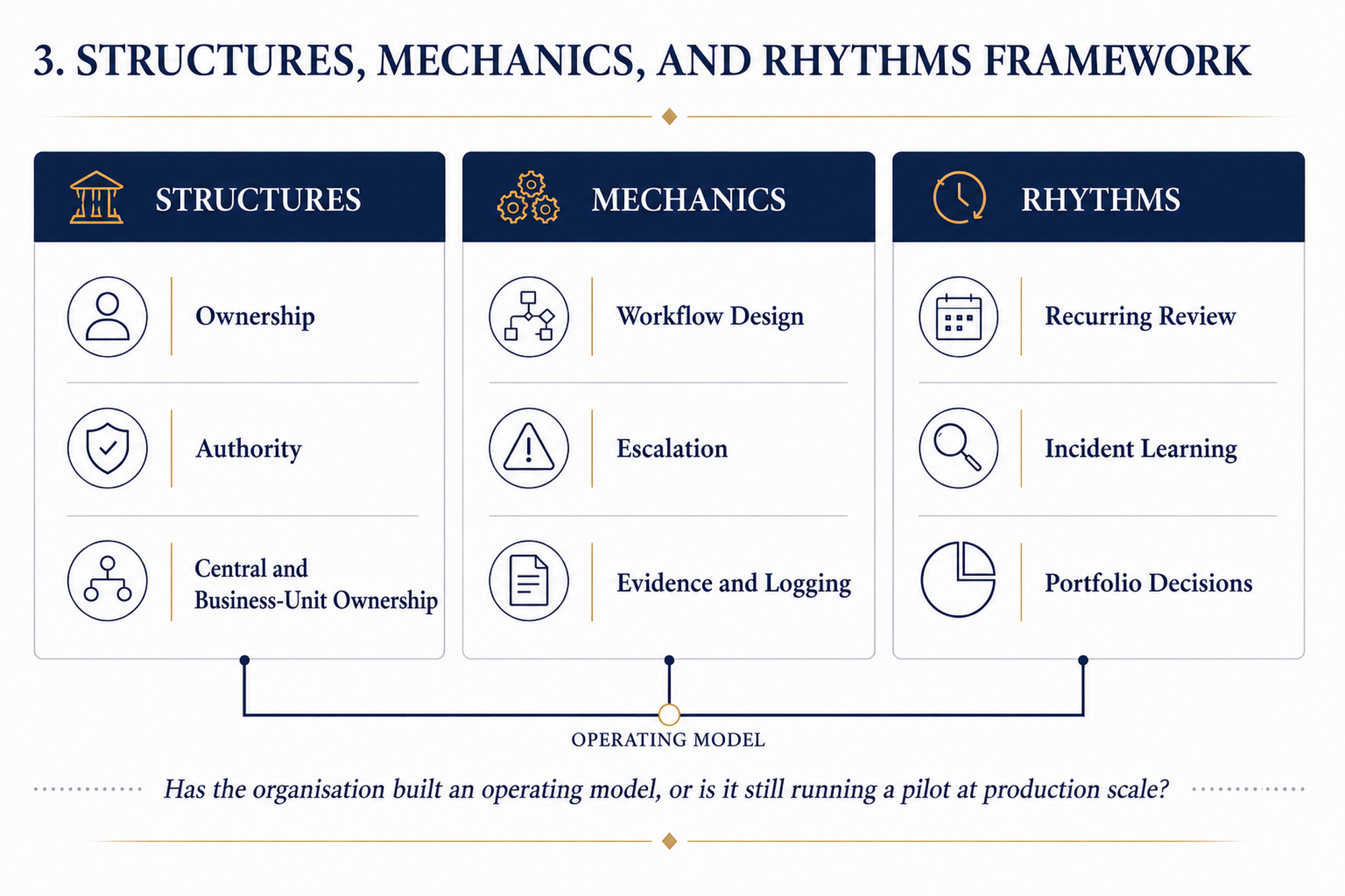
Diagram 2: The Structures, Mechanics, and Rhythms framework helps leaders test whether agentic AI has been built into the operating model or whether the organisation is still running a pilot at production scale.
Structures, Mechanics, and Rhythms
The five shifts describe what needs to change. Executive teams also need a practical way to see where and how those changes become operational.
Operating models have long been examined through combinations of structure, process, technology, people, and decision rights. Horizon SPI’s Structures, Mechanics, and Rhythms lens applies that established logic specifically to workflows in which agents participate directly in execution.
For every material agentic workflow, leaders should examine three parts of the operating model.
Structures: How Responsibility Is Organised
Structures define where ownership sits and how different functions participate. They should clarify which business leader owns the workflow and its outcome and which team owns the agent’s technical operation. They should also show where security, risk, legal, compliance, and data responsibilities sit, who can approve changes to the agent’s authority, and who can pause or withdraw it.
The organisation also needs to decide what should be managed centrally and what should remain with individual business units. Enterprise platforms, identity controls, minimum security standards, and common evidence requirements may need central ownership. The business unit may still own the workflow, local operating decisions, performance, and the consequences experienced by customers or employees.
There is no universal arrangement. The design question is whether local teams can adapt the agent to the work without weakening enterprise controls or obscuring accountability.
A committee cannot compensate for missing ownership. An AI council may provide coordination, but the business consequence still belongs to the leader responsible for the process.
Mechanics: How the Work Actually Operates
Mechanics cover the workflow in practice: the work the agent performs, the data and tools it uses, human intervention points, escalation and override procedures, exception handling, operating instructions, logging and evidence, incident response, and the process for changing authority or access.
This is where governance leaves the policy document. Decision rights need to appear in the workflow. Human oversight requires a reviewer who knows what to examine, has enough time and information, and can intervene when something is wrong. Escalation only works when concerns have a defined destination and someone is expected to respond.
Agent failures should also be treated as operating events, not only technology defects. A technical team may correct the model or configuration. The business should still examine why the failure was not prevented, detected, or contained inside the process.
Rhythms: How the Organisation Learns and Adjusts
Rhythms are the recurring reviews that keep the operating model current. They may cover agent and workflow performance, incidents and near misses, overrides and escalations, permissions and tool access, decision boundaries, and portfolio-level choices to expand, limit, redesign, or retire an agent.
The cadence should reflect consequence and scale. A low-risk internal productivity agent may require modest oversight. An agent influencing financial decisions, employment, customer access, safety, or legal obligations needs closer attention.
The important point is that the review exists before something goes wrong.
Together, Structures, Mechanics, and Rhythms give leaders a practical test: has the organisation built an operating model around the agent, or is it still running a pilot at production scale?
Funding the Operating Change
Agentic AI business cases often begin with the cost of technology and the value of time saved. That starting point is understandable, but incomplete.
The cost of the agent is visible. The cost of redesigning the work around it is often dispersed across operations, management, training, risk, security, data, and technology.
A proof of concept may be funded through an innovation budget and supported manually by a small team. Exceptions may be handled informally, while senior attention compensates for missing processes. The pilot appears economical because the surrounding organisation is absorbing work that has not been counted.
That model becomes difficult to sustain when the agent enters normal operations. The organisation then needs to fund workflow ownership, integration, monitoring, training, incident readiness, access management, and periodic redesign.
These costs should form part of the business case from the beginning. A use case that only works when oversight, exception handling, and operating ownership are excluded from the calculation may not be economically sound.
- Executive observation: Control belongs inside the economics of agentic AI. It is part of the cost of producing a dependable outcome.
The Changing Role of the Manager
Managers sit at a critical point in the agentic operating model, yet many are not being prepared for the role.
Executives can approve a strategy, technology teams can deploy the systems, and governance functions can define rules. Managers are often the people who must make the combined arrangement work every day.
They will see where employees rely too heavily on agents, where people resist useful automation, where escalation creates delay, and where a workflow looks efficient on a dashboard but feels broken in practice.
Their role will increasingly include supervising hybrid workflows, examining recurring exceptions, deciding when agent autonomy should expand or contract, protecting the quality of human judgment, and recommending changes to the division of work.
Microsoft’s 2026 Work Trend Index found that employees whose managers actively modelled AI use and created psychological safety around experimentation reported up to 20 points higher AI readiness and value. They were also 1.4 times more likely to be high-frequency users of agentic AI. These are self-reported associations, not proof that manager support caused the result. They still reinforce a practical point: management behaviour shapes whether AI becomes useful organisational practice.
Managers need enough understanding to question the workflow. They need useful evidence, authority to intervene, and a culture where slowing or stopping an agent can be treated as responsible management rather than resistance to innovation.
They should not be treated as the final safety net for systems they did not design and cannot control. They should have a defined role in how those systems are reviewed and improved.
Leadership Rhythms for Staying in Control
Executive oversight should concentrate on the operating exposure created by agents, not simply on how many have been deployed.
A useful portfolio review might examine:
- which material workflows now depend on agents;
- the authority each agent has;
- the business owner for each workflow;
- performance, exceptions, incidents, and overrides;
- proposed expansions of data, tools, or decision rights;
- whether human oversight remains effective;
- whether the business case still holds after operating costs;
- which workflows need redesign rather than further automation.
The review should not become another reporting exercise. Its purpose is to identify changes that require a leadership decision.
Should this agent be allowed to act in more situations? Has the volume of human intervention become too high? Are repeated exceptions showing that the workflow is poorly designed? Has the agent changed the practical location of a decision? Does the accountable leader still have enough visibility? Should the deployment be expanded, restricted, redesigned, or stopped?
Boards may not need detailed reports on every agent. They do need assurance that management understands where agents affect material outcomes, how authority is controlled, and how failures travel through the organisation.
The reporting should match the consequence.
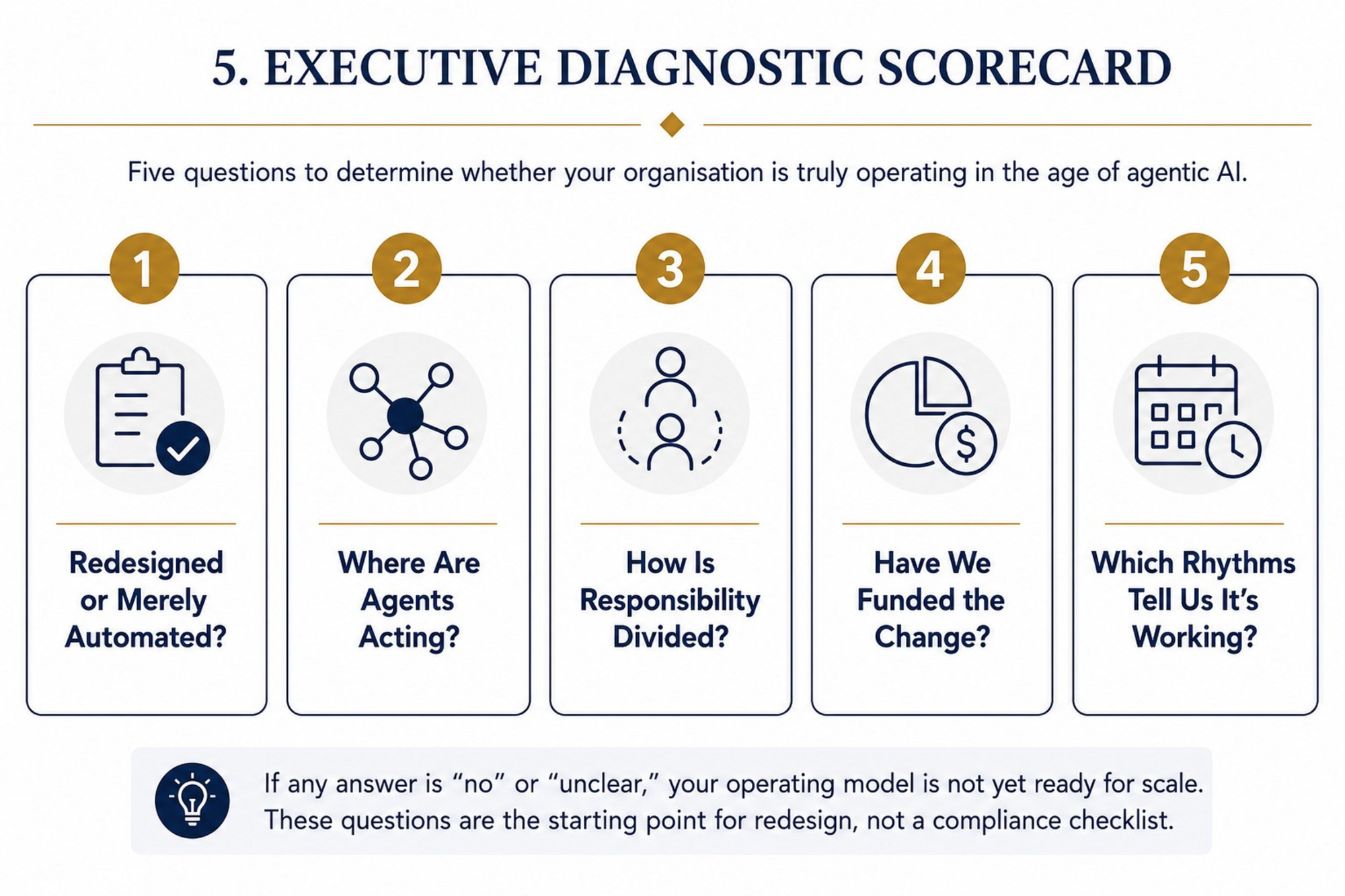
Diagram 3: The Executive Diagnostic Scorecard gives leadership teams five questions to test whether agentic AI is being supported by a real operating model or only by automation activity.
An Executive Diagnostic
Executive teams can begin with five questions.
1. Which workflows are being redesigned rather than merely automated?
Look beyond the number of use cases. Identify whether the organisation has reconsidered the full path of the work, including handoffs, decisions, exceptions, and outcomes.
2. Where are agents beginning to initiate, coordinate, or complete work?
An inventory of tools provides only part of the picture. Leaders need visibility into where agents are taking actions and influencing operational decisions.
3. How is responsibility divided between people and agents?
Define what agents perform, where human judgment remains necessary, and who owns the combined outcome.
4. Have we funded the operating change, or only the technology?
Include workflow redesign, integration, training, monitoring, risk work, and management capacity in the business case.
5. Which management rhythms tell us whether the system is working?
Review operational outcomes, overrides, incidents, escalation patterns, human workload, incentives, and changes in exposure. Adoption and usage measures alone will not show whether the system is working.
The Executive Perspective
Agentic AI enters organisations that already have workflows, budgets, reporting lines, performance measures, and habits.
Some of those structures will support it. Others will work against it.
An agent may be technically capable and properly governed, yet still fail to create durable value because the organisation has not changed the work around it. The process remains fragmented. Managers cannot see enough. Employees are unsure when to intervene. Accountability stays on paper while practical authority moves elsewhere.
The operating model is where those tensions become visible.
Article 5 established the architecture required to govern agents. Article 6 carries that architecture into the organisation through redesigned workflows, hybrid responsibility, bounded autonomy, realistic funding, management practice, incentives, and recurring review.
Public evidence of completed operating-model redesign remains limited. The clearer pattern is that organisations are discovering the need for it while deployments are already moving forward. Klarna’s experience shows why that learning cannot stop at launch.
Agentic AI, therefore, becomes an organisational design issue that extends beyond individual deployments.
Where in your organisation is an agent already acting inside a workflow that was never redesigned around it, and who is accountable for what happens next?
________________________________________________________________________________________________
Selected References
- IBM Institute for Business Value. Agentic AI’s Strategic Ascent: Shifting Operations from Incremental Gains to Net-New Impact. October 2025.
- Deloitte. Enterprise AI Trends 2026: AI Transformation Strategy. June 2026.
- Deloitte. The State of AI in the Enterprise, 2026.
- Deloitte. Getting Human and Machine Relationships Right. Global Human Capital Trends 2026.
- Deloitte. Cutting Roles Creates Budget, Not Value. June 2026.
- Microsoft. 2026 Work Trend Index: Agents, Human Agency, and the Opportunity for Every Organization. May 2026.
- Klarna. Klarna AI Assistant Handles Two-Thirds of Customer Service Chats in Its First Month. February 2024.
- Customer Experience Dive. Klarna Changes Its AI Tune and Again Recruits Humans for Customer Service. May 2025.
- Horizon SPI. Agentic AI Governance: How to Build the Operational Foundations for Scale. Article 5 of The Agentic AI Economy.
© 2026 Horizon SPI. All rights reserved.
Executive Intelligence Series | horizonspi.com
This article is the sixth in the Horizon SPI Executive Intelligence Series: The Agentic AI Economy. Article 7 will examine the executive readiness required for agentic AI, including leadership discipline, governance maturity, organisational capability, and strategic response.