
EXECUTIVE PERSPECTIVES | HORIZON SPI
AI Adoption Is a Capital Allocation Decision
Most organizations approach AI as a technology initiative.
What often determines success or failure is whether leadership governs AI with the same discipline applied to any major capital investment.
This article is part of the Horizon SPI Executive Perspectives series on AI strategy, governance, and executive oversight.
Many organizations begin with an incomplete question when they think about AI.
They ask, "Which tools should we adopt?" "Which vendors should we evaluate?" "Which departments should pilot first?"
The question that actually determines outcomes is different: are we prepared to govern this initiative as a capital decision?
AI becomes more than a technology upgrade when it reshapes capital deployment, decision-making, and enterprise structure. Organizations that treat it as a procurement exercise consistently find themselves with activity but not value. Pilots accumulate. Spending increases. And at the leadership level, no one can clearly explain what the investment is producing.
I have seen this pattern repeat across industries and organization sizes. The problem is usually not the technology. It is the absence of the capital discipline that any major investment requires.
The Misclassification Problem
At the root of most AI failures is a simple but consequential misclassification.
AI initiatives are typically routed through IT budgets, innovation teams, or digital transformation offices. These structures are well suited to deploying software tools. They are poorly designed to govern investments that fundamentally reshape operating models, decision architectures, and workforce structures.
The pattern is predictable. BCG research shows that 74% of companies have yet to show tangible value from their AI investments, not because the technology fails, but because adoption is driven by competitive anxiety rather than a clearly articulated investment thesis.¹ Organizations launch large numbers of experimental initiatives without portfolio discipline. Activity expands. Value remains elusive.
When AI is treated as a technology decision, it gets technology-level oversight. That is not sufficient for an investment of this scale and consequence.
What Governance Failure Actually Looks Like
The signs of ungoverned AI adoption are consistent across organizations.
AI development, data ownership, risk oversight, and operational deployment are distributed across departments with no integrating authority. Compliance frameworks get mistaken for accountability structures; they address risk containment, not strategic value creation. Pilots proliferate without scalability criteria. And at the board level, formal AI oversight remains the exception rather than the rule.
The financial consequences are measurable. Deloitte research shows that most organizations take two to four years to realize ROI on a typical AI use case, significantly longer than the seven to twelve months expected from conventional technology investments.² Gartner predicts that by 2027, 60% of organizations will fail to realize expected AI value due to inadequate governance frameworks.³
This is not a technology problem. It is a management problem.
What AI Leaders Do Differently
Organizations that consistently generate value from AI share a specific pattern, one that relates less to the tools they select and more to how they govern what they build.
Rather than launching large portfolios of exploratory pilots, high-performing organizations concentrate resources on a small number of strategically prioritized initiatives. BCG research on AI value creation shows a consistent allocation pattern among leaders: approximately 10% of investment in algorithms, 20% in technology and data infrastructure, and 70% in people, operating processes, and organizational transformation.¹
Software does not create the majority of AI value. Organizational redesign creates it. Organizational redesign requires executive ownership, not IT sponsorship.
The analogy I return to repeatedly: adopting AI without restructuring the organization around it is like introducing electricity into a factory designed for steam power without redesigning the production line. The technology changes immediately. The organization must redesign itself to achieve productivity gains.
The Horizon SPI AI Capital Governance Model
If AI is going to be treated as a capital decision, executives need a governance model that connects investment logic, prioritization, accountability, and transformation design. The framework below provides exactly that structure, a practical tool for evaluating, prioritizing, and governing AI investments with the same discipline applied to any major capital commitment.
Horizon SPI AI Capital Governance Model
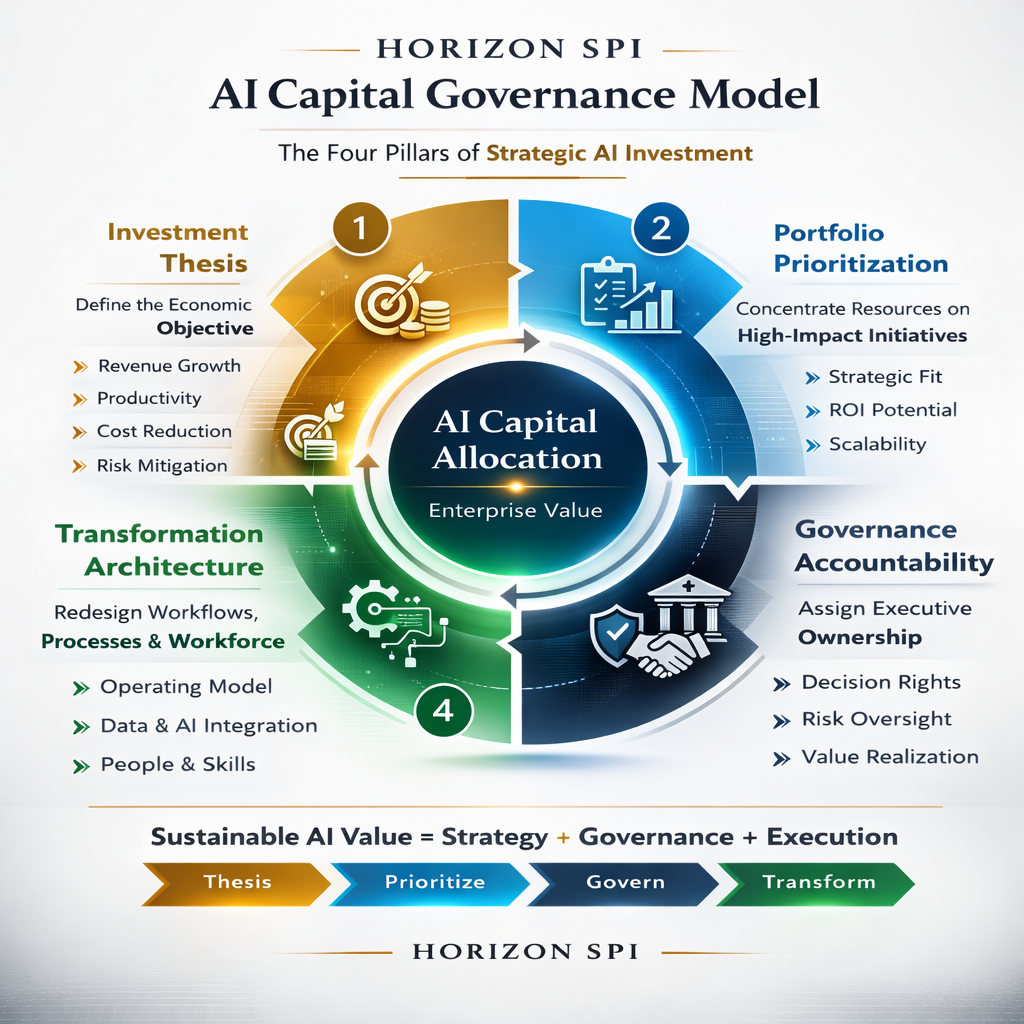
Figure — Horizon SPI AI Capital Governance Model
Investment Thesis:
- Every AI initiative must support a clearly defined business objective.
Portfolio Prioritization:
- Focus resources on a small number of high-impact initiatives.
Governance Accountability:
- Assign executive ownership for risk, coordination, and measurable outcomes.
Transformation Architecture:
- Redesign workflows and operating structures around adoption.
The architecture below outlines the sequence executives should follow when allocating capital to AI initiatives.
Executive AI Capital Allocation Architecture
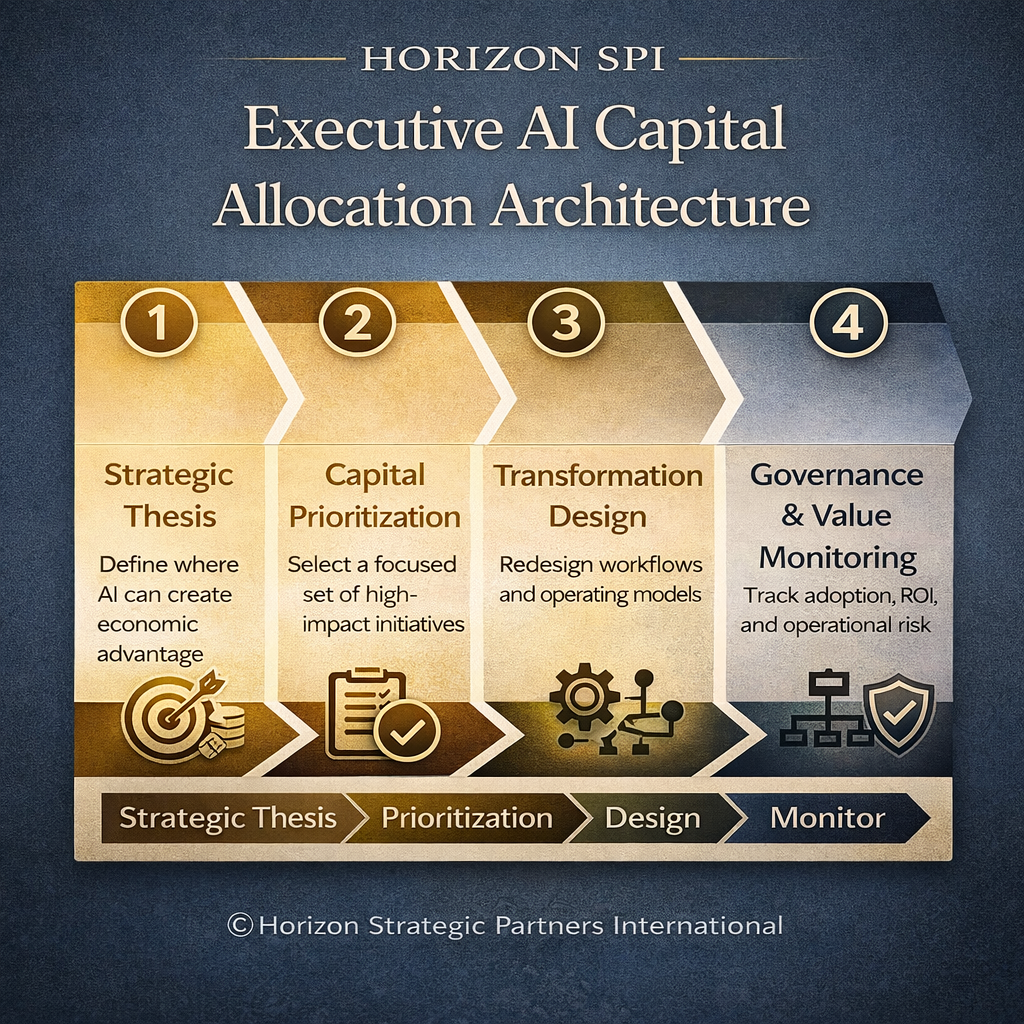
Figure — Executive AI Capital Allocation Architecture
Step 1 — Strategic Thesis:
- Define where AI creates economic value.
Step 2 — Capital Prioritization:
- Select focused initiatives with measurable business impact.
Step 3 — Transformation Design:
- Align workflows, operating models, and execution structures.
Step 4 — Governance & Value Monitoring:
- Track adoption, accountability, ROI, and operational risk.
The Closing Reality
The organizations that capture AI's value will not be those experimenting the fastest. They will be the ones governing it most strategically.
In my experience, the leadership teams that get this right share one thing in common: they made a deliberate decision early on to treat AI with the same rigor they apply to any significant capital commitment. They defined an investment thesis. They assigned accountability. They built the oversight discipline before the complexity arrived.
AI adoption is not primarily a technology decision. It is a capital allocation decision, and it should be governed with the same discipline as any major investment that reshapes the enterprise.
_______________________________________________
Selected Research References
1. Boston Consulting Group — AI Adoption in 2024: 74% of Companies Struggle to Achieve and Scale Value (October 2024)
https://www.bcg.com/press/24october2024-ai-adoption-in-2024-74-of-companies-struggle-to-achieve-and-scale-value
2. Deloitte — AI ROI: The Paradox of Rising Investment and Elusive Returns (2025)
https://www.deloitte.com/global/en/issues/generative-ai/ai-roi-the-paradox-of-rising-investment-and-elusive-returns.html
3. Gartner — via LinkedIn / industry reporting: By 2027, 60% of organizations will fail to realize expected AI value due to incohesive ethical governance frameworks (2025)
https://www.linkedin.com/posts/gartner-for-it-leaders_gartnerda-ai-data-activity-7364666422532141056-NzCh
Horizon Strategic Partners International advises executive leadership teams on AI strategy, governance, and operating model design. This article is part of the Horizon SPI Executive Perspectives series.
Working With Horizon SPI
Horizon SPI works with executive teams navigating AI governance, strategic prioritization, and capital allocation decisions.
Organizations evaluating how to structure AI investment before complexity scales are invited to request a confidential executive strategy conversation.