
The Companies Building the Agentic Economy
How Microsoft, OpenAI, Google, Anthropic, Amazon, and Salesforce are shaping the next enterprise AI platform race
The Agentic AI Economy | Article 3 of 8
Horizon SPI Executive Intelligence Series
By Steven Kiss, MBA | June 2026
Executive Summary
The agentic AI economy is not being built by one company. It is being shaped by six, each pursuing a different theory of where enterprise value will accumulate as AI systems become more autonomous.
Microsoft is betting on distribution. OpenAI is betting on vertical integration. Google is betting on full-stack platform control. Anthropic is betting on safety as a durable competitive moat. Amazon is betting on infrastructure neutrality. Salesforce is betting on workflow ownership.
These are not variations of the same strategy. They reflect different assumptions about how enterprises will deploy, govern, and depend on autonomous AI, and each creates a corresponding dependency for the organizations that build on them.
For executive leaders, the implications are immediate. Vendor selection is no longer only an IT procurement decision. It is an architectural commitment that shapes which company’s vision of the agentic enterprise your organization is betting on and how much strategic flexibility you may be trading away in the process.
This article maps the six strategic positions, identifies the control points each company is building toward, and offers a decision framework for executive teams navigating the next stage of enterprise AI.
In every major platform transition, there is a moment when the field of competitors stops expanding and begins to narrow. Not because the others disappear immediately, but because a small number of companies make architectural bets that define the terms on which others have to compete.
That moment is approaching in agentic AI.
Six companies are making those bets now: Microsoft, OpenAI, Google, Anthropic, Amazon, and Salesforce. Each is helping shape the infrastructure of the agentic economy, but they are not all competing for the same position.
Their strategies reflect different theories of enterprise value, different control points, and different assumptions about how autonomous AI systems will be deployed at scale.
Two distinct tiers are emerging. The first tier (Microsoft, OpenAI, Google, and Anthropic) is competing to define the intelligence and operating layers of the agentic enterprise. The second tier (Amazon and Salesforce) is pursuing an equally consequential bet: controlling the infrastructure backbone and the application workflow layer where agentic systems will run at scale.
For executive leaders making architecture decisions, vendor selections, and governance investments, this is not an abstract exercise in competitive intelligence. Understanding who is building what, and why, is becoming a prerequisite for building an agentic enterprise that remains strategically flexible through the decade. These companies are not only competing for market share. They are competing to define the architecture your organization may come to depend on.
Tier 1: The Intelligence and Operating Layer
These four companies are competing to control how enterprise AI thinks, reasons, and governs itself at the model and platform level.
Microsoft: The Enterprise Integration Bet
Strategic bet: The company that controls the enterprise productivity layer will control the agentic economy.
Microsoft's approach is the most direct expression of a single conviction: distribution wins. Rather than asking enterprises to adopt a new AI platform, Microsoft embeds agents directly into the software already running the enterprise, Teams, Outlook, Excel, Dynamics 365, Power Platform, and SharePoint. With more than 450 million Microsoft 365 commercial seats, the path of least resistance to agentic AI runs directly through Microsoft's stack.[1]
The most significant structural move was Agent 365, introduced at the November 2025 Ignite conference: a centralized control plane providing IT and business leaders with governance and visibility over every AI agent operating in the enterprise, regardless of origin.[2] The 2026 Release Wave 1 extended agentic capabilities across Dynamics 365 Finance, Supply Chain, Sales, and HR, positioning Microsoft to automate end-to-end business processes, not just individual tasks.[3]
Microsoft's primary moat is not technology. It is an installed base combined with governance architecture. In a February 2026 Microsoft AI publication, Mustafa Suleiman's explicit framing of "humanist superintelligence" — coupling capability with human-centric control — is not incidental. For enterprise risk officers navigating AI governance requirements, it is a deliberate competitive positioning decision.[4]
- Executive implication: Microsoft will almost certainly be present in many agentic enterprises. The leadership decision is how much of the enterprise operating layer a single vendor should be allowed to govern. -
OpenAI: The Vertical Integration Bet
Strategic bet: Own the compute infrastructure, the models, and the application layer simultaneously.
OpenAI's trajectory over the past eighteen months has been a study in strategic reinvention. It has moved from a research organization supplying foundational models to an enterprise platform competing directly for the workflows of the organizations it once served as a supplier.
Two developments signal this ambition most clearly. First, the January 2025 launch of Operator, OpenAI's first fully autonomous agent, gave the company a browser-based system capable of interacting with websites and external services through graphical interfaces without requiring APIs or custom integrations, with enterprise application support in subsequent releases.[5] OpenAI was no longer operating only as a model provider. It was building the application layer directly, positioning itself to compete for the workflows it had previously enabled others to build.
Second, and more strategically significant, is the Stargate Project: a $500 billion infrastructure investment backed by SoftBank, Oracle, and Abu Dhabi-based MGX, with OpenAI holding operational responsibility.[6] Stargate is a declaration that OpenAI intends to own the compute infrastructure underlying the agentic economy. The business model evolution reinforces this direction. CFO Sarah Friar has signaled a deliberate shift toward outcome-based revenue arrangements, in which OpenAI takes a share of the value created by agentic applications — moving OpenAI from model provider toward economic participant in the enterprises it serves.[7]
- Executive implication: OpenAI represents both extraordinary capability and expanding platform dependency. As it moves deeper into the application layer, organizations building on its infrastructure may increasingly find themselves inside its commercial ecosystem, not only its technology stack. -
Google: The Full-Stack Platform Bet
Strategic bet: Only Google owns all the layers required to deliver enterprise AI at scale — models, cloud, productivity applications, search, and data infrastructure in a single integrated architecture.
At Google Cloud Next '26 in April 2026, Google consolidated its AI products under the Gemini Enterprise brand and repositioned it as a full agentic operating environment spanning Google Workspace, Google Cloud, and connected enterprise systems. Google Cloud CEO Thomas Kurian stated at the keynote: "The experimental stage is behind us, and now the actual challenge begins."[8]
The most strategically significant element is the Agent-to-Agent (A2A) protocol, an open standard for agent interoperability running in production at 150 organizations by the time of Cloud Next '26 in April 2026.[9] Combined with support for MCP, A2A represents Google's bid to establish the communication standards governing how enterprise agents talk to one another. Standards leadership compounds over time: once an ecosystem is built on a protocol, displacing it becomes structurally difficult.
The consulting community has aligned rapidly. Deloitte and Accenture both announced expanded partnerships with Google Cloud at Next '26, signaling that Gemini Enterprise is being positioned as a primary deployment environment for large organizations.[10][11]
- Executive implication: Google's full-stack argument is compelling, but committing to Gemini Enterprise means committing broadly to Google's cloud, workplace, and infrastructure stack. The value is real. So is the depth of the architectural commitment required. -
Anthropic: The Safety Moat Bet
Strategic bet: Enterprise trust, built through safety leadership, compounds into durable market share.
Anthropic occupies the most distinctive position in this market and has exceeded analyst expectations. Founded in 2021 by former OpenAI researchers committed to AI safety as a first-order priority, the company pursued a strategy many analysts initially underestimated: build reliable, trustworthy, enterprise-safe AI and allow that reputation to compound into market share.
According to Menlo Ventures' December 2025 enterprise survey, Anthropic now holds approximately 40% of enterprise LLM spend, up from 12% three years ago and ahead of OpenAI's 27% and Google's 21% share.[12] Corporate purchasing data from Ramp's March 2026 AI Index found that Anthropic wins approximately 70% of head-to-head enterprise matchups against OpenAI among first-time enterprise AI purchasers.[13] These figures are sourced from third-party analyst reports and should be treated as directional indicators, but the direction is consistent across multiple independent sources.
The deeper competitive asset is the Model Context Protocol (MCP). Launched by Anthropic in November 2024 and recording nearly 100 million monthly SDK downloads as of early 2026,[14] MCP has become the industry standard for connecting AI agents to enterprise tools and data sources. Microsoft, Google, Amazon, and virtually every major enterprise software vendor now support it. In December 2025, Anthropic donated MCP to the Linux Foundation's Agentic AI Foundation, an act of strategic openness that effectively guarantees long-term ecosystem adoption.[15] Anthropic built the protocol, and the ecosystem followed a standards leadership position that is structurally difficult to displace.
- Executive implication: Anthropic's safety-first positioning is increasingly a procurement argument, not only a philosophical one. For regulated industries and risk-conscious boards, Claude's enterprise credibility and MCP standards leadership are meaningful differentiators. The primary consideration is organizational maturity and scale relative to larger platform providers. -
Tier 2: The Infrastructure and Application Layer
These two companies are not competing to define AI intelligence. They are competing to own the layers where agentic systems are built, deployed, and embedded into enterprise operations at scale.
Amazon / AWS: The Infrastructure Enablement Bet
Strategic bet: Own the infrastructure layer for all model providers not by winning the model race, but by becoming the platform every model runs on.
AWS has made a deliberate and strategically coherent choice. It is not competing to produce the best AI model. It is competing to become the default enterprise AI control plane, the infrastructure layer that hosts, orchestrates, and governs agentic systems regardless of which model they use.
The defining announcement from re:Invent 2025 was the repositioning of AI agents as the next primary unit of enterprise compute. AWS built an entire runtime layer (Amazon Bedrock AgentCore) to make this viable at enterprise scale, with stateful MCP support, multi-agent orchestration, and production-grade governance reaching general availability in early 2026.[16][17] At its March 31, 2026 release, AWS made the AWS DevOps Agent generally available, an autonomous agent that reduces mean time to resolution for IT incidents by correlating telemetry, code, and deployment data across cloud environments. The AWS Security Agent for autonomous penetration testing reached general availability the same day.[18]
The infrastructure strategy is reinforced by AWS's positioning as a neutral multi-model platform. Amazon has committed more than $13 billion to Anthropic to date, with Anthropic pledging to spend over $100 billion on AWS infrastructure over the next decade.[19] OpenAI models and Codex agents are coming to Bedrock, and Meta's open-source models are available on AWS infrastructure. In partnering simultaneously with competing frontier labs, AWS is executing the same infrastructure-neutrality playbook that made it the default cloud platform for a generation of applications.
- Executive implication: AWS represents the lowest-friction path to deploying agentic systems across multiple models without committing to a single intelligence provider. The risk is infrastructure dependence without workflow ownership. AWS can become the operating base for agentic systems without necessarily controlling the business outcomes they deliver. -
Salesforce: The Application Workflow Bet
Strategic bet: Embed agentic capability directly into the business workflows where enterprise value is created, not as a separate tool, but as the operating fabric of CRM, customer operations, and sales execution.
Salesforce's strategic position is distinct from every other company in this analysis. It does not compete on model quality or infrastructure scale. It competes on the basis of workflow ownership. Agentforce 360, announced at Dreamforce 2025 and broadly deployed across enterprise customers by early 2026, is built on the Atlas Reasoning Engine, a multi-step decision-making layer that breaks down customer requests into tasks, retrieves live CRM data, and executes end-to-end workflows with significantly reduced human handoff requirements across Service Cloud, Sales Cloud, Commerce Cloud, and third-party systems.
The commercial traction is significant. Salesforce closed 29,000 total AgentForce deals in its first 15 months — up 50% quarter-over-quarter in Q4 FY2026 — and processed 771 million Agentic Work Units in Q4 alone, a 57% quarter-over-quarter increase.[20] Full-year Agentforce ARR reached $800 million at fiscal year close, and the combined Agentforce and Data 360 ARR reached $2.9 billion.[20] Salesforce reports that its own internal customer service deployment resolves 85% of queries without human involvement, a benchmark the company uses to demonstrate the platform's enterprise-grade capability.
Salesforce's most architecturally significant 2026 move was "Headless 360", exposing the entire Salesforce platform as an API, an MCP tool, and a command-line interface. In the words of CEO Marc Benioff: "No Browser Required. Our API is the UI."[21] This means any external AI agent — Claude, Codex, or a custom enterprise model — can build, configure, and operate Salesforce directly without a graphical interface. Salesforce is positioning itself as the platform where agents run, not the interface users interact with.
- Executive implication: Salesforce offers strong value for organizations where agentic AI use cases center on customer operations, sales, and service workflows. As Agentforce becomes more embedded in enterprise operations, workflow execution becomes more closely coupled to the Salesforce platform. That dependency grows with the value delivered. -
The Strategic Map: Six Bets, One Transition
These six companies are not executing variations of the same strategy. They hold structurally different theories of where value will accumulate in the agentic economy. The table and framework below are designed as decision tools, not vendor comparisons.
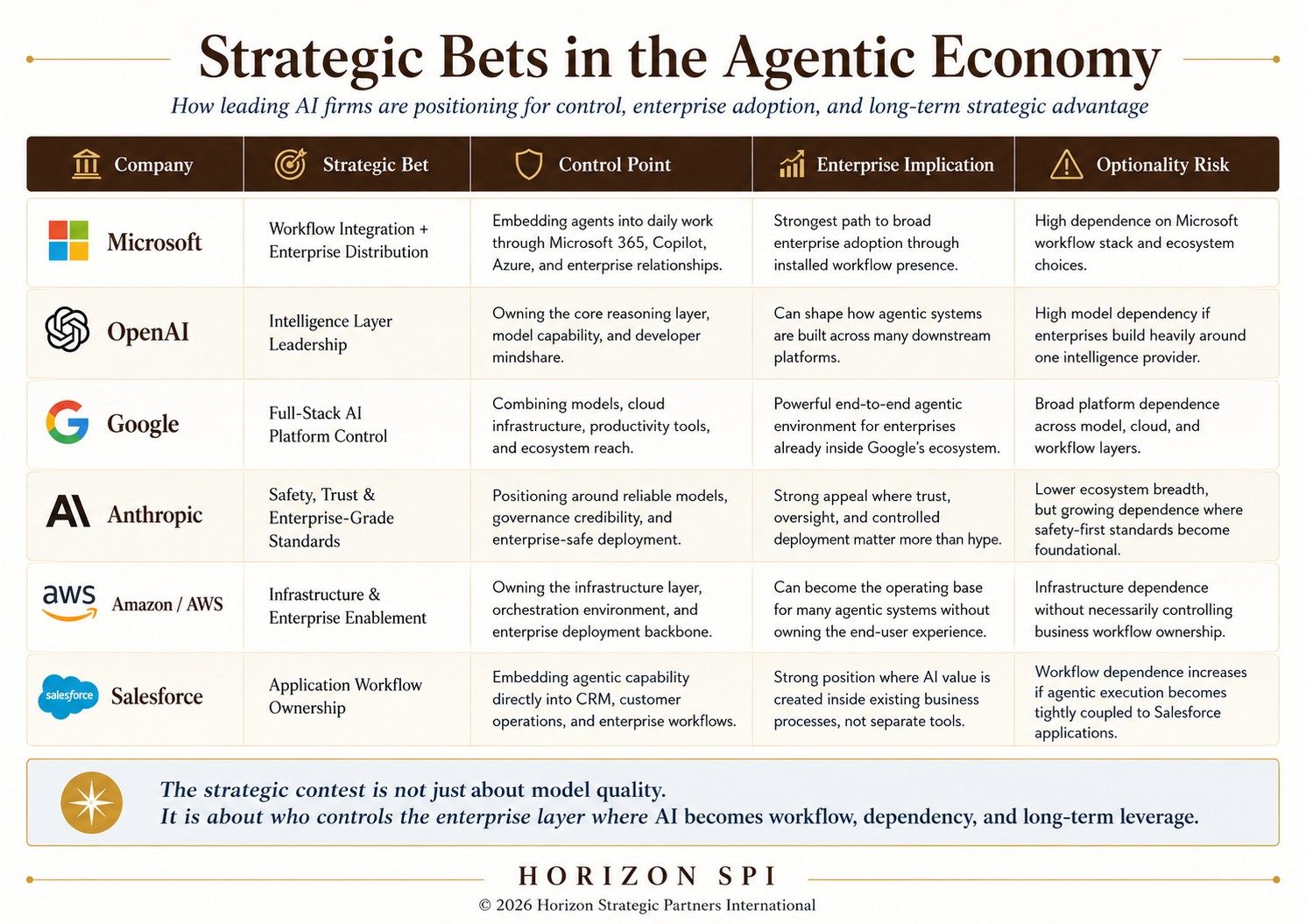
Diagram 1. Strategic Bets in the Agentic Economy — Horizon SPI Executive Intelligence Series
The strategic contest is not only about model quality. It is about who controls the enterprise layer where AI becomes workflow, dependency, and long-term leverage.
The table reveals a practical tension. Each company is building a position defensible on its own terms. Each also creates a corresponding dependency. The organizations that manage this best are not the ones that avoid commitment that is impossible at scale. They are the ones that make their commitments deliberately, with clear eyes about what they are trading away in optionality.
What Executives Need to Understand
The competitive dynamics described in this article are moving faster than most enterprise planning cycles. Three observations matter for executive teams.
First: vendor selection is now a strategic architecture decision.
Choosing a primary agentic platform is now an architectural decision. It determines which company's theory of enterprise AI value your organization is betting on, and how deeply that company's infrastructure may become embedded in your operations. Organizations that treat this as a software selection exercise may find themselves locked into architectural dependencies they did not consciously choose.
Second: the market share map has already inverted.
Anthropic's reported rise from 12% to approximately 40% of enterprise LLM spend in under three years is, if accurate, one of the fastest competitive position shifts in enterprise technology history.[12] At the same time, Salesforce closed 29,000 total Agentforce deals in its first 15 months — up 50% quarter-over-quarter in Q4[20] — and AWS is expanding from infrastructure provider toward full-stack agentic platform. Organizations that assessed this competitive landscape twelve months ago are working with an outdated map.
Third: open standards reduce strategic risk.
MCP and A2A are not just technical protocols. They are mechanisms for preserving architectural flexibility as the competitive landscape continues to shift. Building agentic infrastructure on open standards is not a hedge. it is a discipline. It preserves the organizational right to change direction as the market evolves, without dismantling everything built so far. Notably, both Anthropic (MCP)[15] and Google (A2A)[9] have built their standards strategies around openness, recognizing that ecosystem adoption can become more durable than proprietary lock-in.
The companies profiled in this article will not be the only significant players in the agentic economy by 2030. They are the six whose decisions now shape the infrastructure that will either enable or constrain every organization's autonomous AI ambitions.
The question for executive leadership is not which company is winning. It is which architectural bets align with your organization's long-term strategic interests, and whether you are making those bets deliberately or by default.
Which vendor's vision of the agentic enterprise most closely aligns with where your organization needs to go and what are you trading away to get there?
_______________________________________________________________________________________________________________
Selected References
[1] Microsoft Q2 FY26 Earnings — 450M Microsoft 365 Seats (January 28, 2026)
https://office365itpros.com/2026/01/30/microsoft-fy26-q2-results/
[2] Microsoft Ignite 2025 — Agent 365 Announcement
https://news.microsoft.com/ignite-2025-book-of-news/
[3] Microsoft — 2026 Release Wave 1: Dynamics 365 and Power Platform Agentic Capabilities
https://learn.microsoft.com/en-us/dynamics365/release-plans/
[4] Microsoft AI — Mustafa Suleiman: Towards Humanist Superintelligence (February 2026)
https://www.microsoft.com/en-us/research/blog/
[5] OpenAI — Introducing Operator (January 2025)
https://openai.com/index/introducing-operator/
[6] OpenAI — Announcing The Stargate Project (January 21, 2025)
https://openai.com/index/announcing-the-stargate-project/
[7] Sarah Friar, OpenAI — A Business That Scales with the Value of Intelligence (January 2026)
https://openai.com/index/a-business-that-scales-with-the-value-of-intelligence/
[8] Google Cloud Next '26 Keynote — Gemini Enterprise Agent Platform (April 2026)
[9] The Next Web — Google Cloud Next 2026: AI Agents, A2A Protocol at 150 Organizations (May 2026)
https://thenextweb.com/news/google-cloud-next-ai-agents-agentic-era
[10] Deloitte — Deloitte Accelerates AI Transformation on Gemini Enterprise (April 22, 2026)
[11] Accenture — Accenture and Google Cloud Expand Partnership to Scale Agentic Transformation (April 22, 2026)
[12] Menlo Ventures — 2025 State of Generative AI in the Enterprise (December 2025)
https://menlovc.com/perspective/2025-the-state-of-generative-ai-in-the-enterprise/
[13] Ramp — AI Index March 2026: Enterprise AI Purchasing Patterns (March 10, 2026)
https://ramp.com/leading-indicators/ai-index-march-2026
[14] Anthropic — Introducing the Model Context Protocol (November 2024)
https://www.anthropic.com/news/model-context-protocol
[15] Anthropic / Linux Foundation — Donating MCP and Establishing the Agentic AI Foundation (December 2025)
[16] AWS — Amazon Bedrock AgentCore: Now Generally Available (October 2025)
https://aws.amazon.com/blogs/machine-learning/amazon-bedrock-agentcore-is-now-generally-available/
[17] AWS — Bedrock AgentCore Policy Generally Available (March 2026)
[18] AWS — AWS DevOps Agent & Security Agent: General Availability (March 31, 2026)
[19] Amazon / Anthropic — Amazon and Anthropic Expand Strategic Collaboration: $13B+ Committed (April 19, 2026)
[20] Salesforce — Q4 FY2026 Earnings Press Release: Agentforce 29,000 Deals, $2.9B ARR (February 24, 2026)
[21] Salesforce — The Agentic Work Unit: Converting Raw Intelligence into Real Work (February 2026)
https://www.salesforce.com/blog/agentic-work-unit/
© 2026 Horizon SPI. All rights reserved.
Executive Intelligence Series | horizonspi.com
This article is the third in the Horizon SPI Executive Intelligence Series: The Agentic AI Economy. Article 4 moves from the companies building the agentic economy to the organizations deploying it, the use cases generating the most measurable value, the sectors moving fastest, and the implementation realities no vendor's case study will tell you about.