
Agentic AI Governance: How to Build the Operational Foundations for Scale
Oversight frameworks, risk controls, and accountability structures for a world in which AI agents act, not just advise
The Agentic AI Economy | Article 5 of 8
Horizon SPI Executive Intelligence Series
By Steven Kiss, MBA | July 2026
Executive Summary
Agentic AI is beginning to move faster than the governance model around it.
The first four articles in this series traced the shift from generative to agentic AI, explained how agentic systems are built, examined the platforms shaping the enterprise stack, and looked at what happens when agents reach production. Article 5 turns to the harder question: What must be in place before organisations allow agents to operate across more consequential workflows?
This article examines the oversight frameworks, risk controls, and accountability structures required before agentic AI can scale responsibly. It looks at the governance gap now emerging in enterprise adoption, the regulatory and security blueprints beginning to take shape, and the five operating pillars that leadership teams need to build before autonomous systems become deeply embedded in the business.
The central argument is simple: agentic AI governance cannot remain a policy exercise. Once agents begin acting across workflows, governance has to become operating architecture.
Agentic AI is beginning to move faster than the governance model around it.
This is the fifth article in the Horizon SPI Executive Intelligence Series: The Agentic AI Economy. The first four articles traced the shift from generative to agentic AI, explained how agentic systems are built, examined the platforms shaping the enterprise stack, and looked at what happens when agents reach production. Article 4 showed early value and early breakdowns appearing side by side. That leaves a harder question: what must be in place before organisations allow agents to operate across more consequential workflows? This article examines the oversight, controls, and accountability structures needed before scale.
The evidence is not especially reassuring. Agentic AI capability is advancing faster than most enterprise guardrails. Deloitte’s 2026 State of AI in the Enterprise report, based on a survey of 3,235 business and IT leaders across 24 countries, found that only 21% of organisations have mature governance in place for AI agents. Gartner, meanwhile, predicts that more than 40% of agentic AI projects will be cancelled by the end of 2027 because costs rise, business value remains unclear, or controls are not strong enough.
Deployment is moving ahead while governance is still being assembled around it. The widening gap is becoming a serious enterprise risk.
Why Governance Has Become the Strategic Question
For a while, organisations could let governance trail the pilot. They could test a narrow use case, keep the exposure contained, and decide later what a production model would require. That window is closing. As capabilities expand, regulators become more specific, and boards ask sharper questions, governance moves into the strategic conversation.
The EU AI Act makes this shift visible, although its implementation timetable has changed. Under the latest EU timetable, rules for high-risk systems in areas such as biometrics, critical infrastructure, education, employment, migration, asylum, and border control are expected to apply from 2 December 2027. High-risk AI integrated into regulated products, such as lifts or toys, would follow on 2 August 2028.
The dates matter, but the deeper message matters more. The Act is pushing risk management, data governance, technical documentation, logging, human oversight, post-market monitoring, robustness, and cybersecurity into operating practice. For organisations deploying agents in high-risk settings, governance can no longer remain a policy document waiting to be interpreted later.
Singapore approaches the problem from closer to the agent itself. Its government-led Model AI Governance Framework for Agentic AI deals directly with autonomous agents rather than treating them as another form of traditional machine learning. It asks four practical questions: how risk is bounded before deployment, how people remain meaningfully accountable, which technical controls need to exist, and what end users need to understand about their own responsibilities.
Security teams arrive at the same point from another direction. The OWASP Top 10 for Agentic Applications, released in late 2025, treats agents as a distinct attack surface. Its risks include manipulated goals, unsafe tool use, weak identity and session controls, and code execution outside intended boundaries. None of this stays theoretical once an agent can read data, write code, call tools, and trigger workflows.
- Executive observation: Governance is not there to slow agentic AI down. It is there to prevent organisations from discovering, too late and at scale, that autonomous systems were built on weak accountability, unclear decision rights, and incomplete security controls.
The Governance Gap in Numbers
The governance gap becomes easier to see when the numbers are placed side by side.
Deloitte’s 2026 survey found that only 21% of respondents reported mature governance for agents. Behind that number sits a practical problem: most organisations still do not have clear boundaries for what agents can decide on their own, monitoring that catches unusual behaviour in real time, or audit trails that show the full chain of agent actions. Workato and Harvard Business Review’s work on the enterprise AI trust gap points to the same tension: 86% of organisations plan to increase investment in agentic AI, but only 6% trust agents to autonomously handle core end-to-end business processes.
Gartner’s agentic AI forecast adds another warning. More than 40% of initiatives are expected to be cancelled by 2027, mainly because costs escalate, value cases remain unclear, or governance is not strong enough. At the same time, Gartner projects that by the end of 2026, 40% of enterprise applications will feature integrated task-specific AI agents, up from less than 5% today.
Taken together, the findings describe a market that is willing to invest before it is ready to trust. Agents are moving quickly into the application layer, while governance maturity is not keeping pace.
That is not only an implementation problem. It is an architecture problem.
- Executive observation: Durable value from agentic AI is unlikely to come from deploying the most agents the fastest. It is more likely to come from building the strongest governance foundations around the agents that matter most.
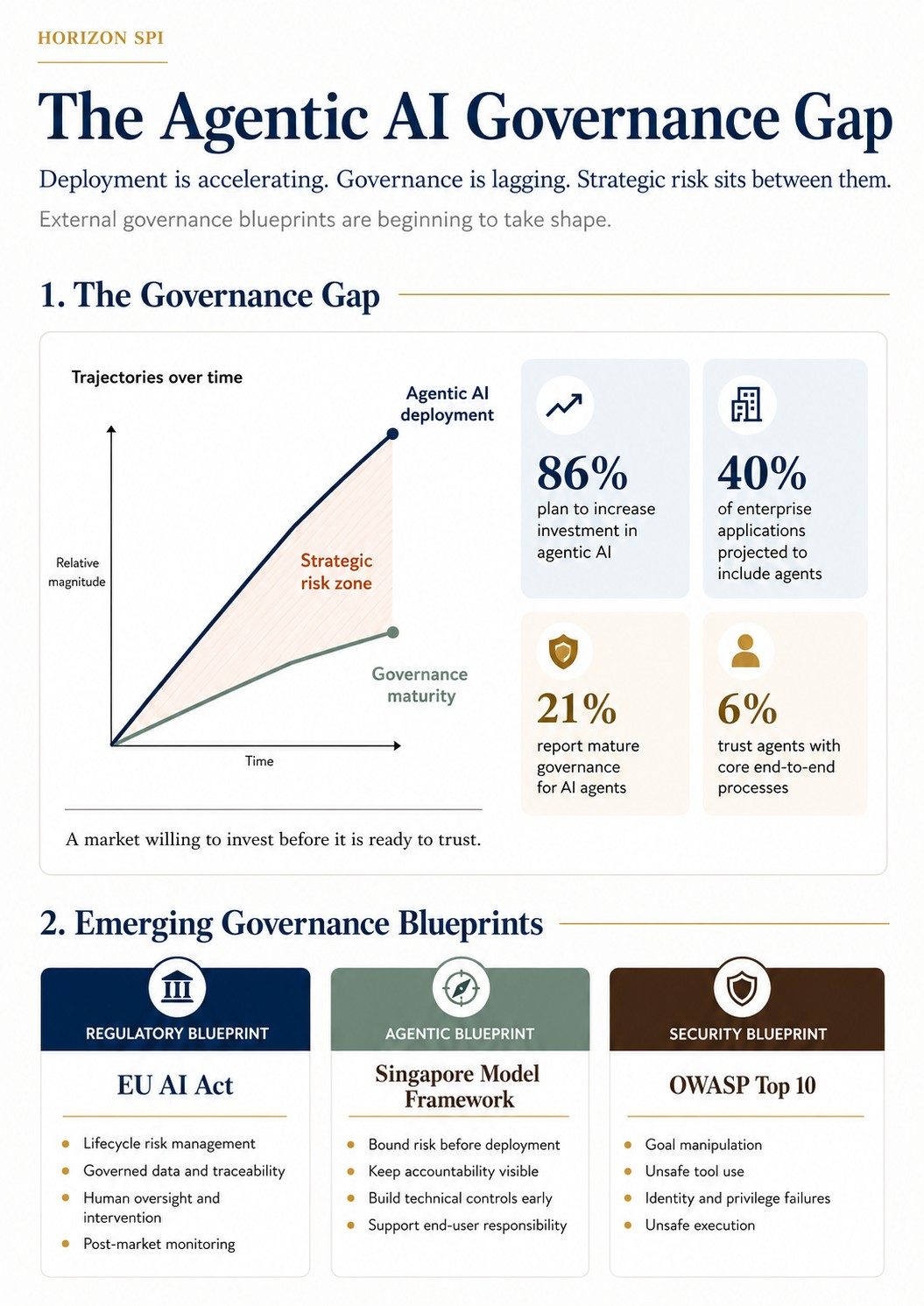
Diagram 1: The Agentic AI Governance Gap shows the widening distance between agentic AI deployment and the governance foundations required to scale it responsibly.
From Compliance to Architecture: A Different Kind of Governance
The difficulty begins with a mismatch. Many enterprise governance models were designed for systems that provide information or recommendations. Agentic systems can go further: they can initiate actions, call tools, and move work without waiting for a person at every step.
Traditional model governance still matters. Data lineage, validation, performance monitoring, and bias controls remain part of the work. Those disciplines, however, do not fully answer what happens when agents initiate actions, interact with systems, and make operational decisions.
A workable governance model therefore has to answer four operating questions:
- Decision rights and accountability: Who is answerable when an agent acts, and how are decisions divided between people and systems across the workflow?
- Operational boundaries: What is the agent allowed to do, which tools can it use, which systems can it touch, and when must it stop?
- Security and resilience: How are agent identities, permissions, and tool access controlled so misuse, escalation, or unsafe execution does not become a production incident?
- Oversight, audit, and learning: How are agent actions recorded, reviewed, and used to improve both the system and the governance model?
On paper, these can look like technical questions. In practice, they reach into organisational design, risk appetite, legal accountability, and board oversight. Agentic AI governance therefore has to be built as architecture, not left as paperwork.
Emerging Governance Blueprints
The governance gap is real, and the foundations are beginning to take shape. Three blueprints are especially useful for executive teams.
1. The Regulatory Blueprint: EU AI Act
The EU AI Act was not designed specifically around agents. Even so, it gives executive teams a useful place to begin when agentic systems enter high-risk workflows. Its requirements translate into a familiar set of disciplines:
- Lifecycle risk management.
- Governed training, validation, and testing data.
- Technical documentation and records that make traceability possible.
- Human oversight that enables intervention and control.
- Defined standards for accuracy, robustness, and cybersecurity.
The post-market obligations matter especially because an agent does not stop presenting new questions simply because it has passed a pre-deployment test. It can behave differently when it meets live data, real users, and edge cases that were absent from testing. Incident reporting, review, and correction therefore have to continue after launch.
2. The Agentic Blueprint: Singapore’s Model Framework
Singapore’s framework comes closer to the problem as organisations will experience it in practice. Because it focuses explicitly on agents, its recommendations translate into four operating disciplines:
- Bound risk before deployment: Limit the tools and data an agent can reach, define acceptable error for the specific domain, and make sure there is a clear way to stop or contain the system when it behaves unexpectedly.
- Keep humans meaningfully accountable: Responsibility has to remain visible across business decision-makers, product teams, and cybersecurity. Human review should provide judgment and intervention, not become the point where responsibility disappears.
- Build technical controls early: Least-privilege access, sandboxed execution, and staged deployment controls are much easier to establish before an agent enters production than after it has already become part of the workflow.
- Support end-user responsibility: Users need enough transparency to understand what the agent can do, how it handles data, where escalation goes, and what failure may look like.
That is what makes the framework useful beyond Singapore. It treats agent governance as an operating design problem and helps organisations govern agents for what they actually are, rather than as generic AI tools with a new label.
3. The Security Blueprint: OWASP Top 10 for Agentic Applications
OWASP brings the security reality into the picture. Its Top 10 for Agentic Applications 2026 focuses on what can happen when an agent’s goals, tools, identity, or execution path are manipulated:
- Goal manipulation and prompt injection.
- Unsafe or exploited tool use.
- Identity, session, and privilege failures.
- Code execution and tool invocation outside intended boundaries.
These are not risks to hand over to a policy team after deployment. They have to be designed against from the beginning. Hardened sandboxes, tool allowlists, authentication, output validation, and review before system-level actions all belong inside the governance architecture.
- Executive observation: Regulation, agent-specific design, and security practice are beginning to converge. None is sufficient on its own. Read together, they point toward a new discipline: agentic AI governance architecture.
Five Pillars of Agentic AI Governance
Read together, these blueprints begin to form a practical operating model. Horizon SPI’s framework brings them into five pillars that can be used in day-to-day governance. The purpose is not another policy document. It is to make ownership, boundaries, controls, monitoring, and human judgment visible in the way the organisation actually operates.
Pillar 1: Decision Architecture and Accountability
An agent may be measured by performance, but its decisions still need an owner.
Decision architecture comes first. The organisation has to decide which actions an agent may take alone, which require human approval, and which it may only inform.
That map needs to be explicit, documented, and tied to risk appetite. High-stakes, irreversible, or legally sensitive decisions should remain subject to human approval or review. Routine, reversible, low-impact decisions may allow agents to act with greater autonomy, provided clear limits, monitoring, and escalation paths remain in place.
Once the map is clear, accountability becomes easier to place. Someone must own what happens when an agent acts, escalates, fails, or reaches the edge of its authority. Singapore’s framework points in the same direction: responsibility should be visible across business owners, product teams, security, and compliance, with a documented chain that does not disappear when the workflow crosses functions.
Pillar 2: Data, Tools, and Access Governance
Agents act through the data, systems, and tools they are allowed to reach. That makes permissions one of the most practical governance controls available.
An agent is only as safe as the access around it. Governance needs to define what data it can use, which tools it can call, and what rules apply when those tools are invoked.
Least privilege access: Give an agent only what it needs for the job in front of it. Broad access may be convenient during development, but in production it can turn a small error into a much larger one.
Scoped tool sets: Decide in advance which tools an agent may call and under what conditions. A tool should not become available simply because it is technically easy to connect.
Data quality and policy alignment: Training and live data need to reflect current policies. Failures that first look like model problems often begin with stale, conflicting, or poorly governed information.
This pillar ties AI governance to data governance, identity, and access management. Many organisations are still maturing those foundations. Agentic AI often exposes weaknesses that already exist by reaching across systems, data, and permissions more quickly.
Pillar 3: Risk Management and Security Controls
Security has to be part of agentic design from the beginning.
Agentic AI risk extends beyond the model’s output. It includes how the agent behaves, which systems it can influence, and what happens when several actions compound under real operating pressure. Threat modelling should account for memory poisoning, prompt injection, privilege escalation, and tool misuse.
OWASP’s risk categories make the control implications concrete: sandbox code execution, validate tool outputs, restrict direct command execution, and tightly limit when an agent can invoke sensitive tools.
Incident response belongs in the design as well. When an agent fails, behaves unexpectedly, or creates a security event, people should already know who takes control, how the issue is escalated, what must be investigated, and how the system returns safely to service.
The aim is plain: agents should not become the weakest link in the enterprise security stack.
Pillar 4: Monitoring, Audit, and Post-Market Learning
Launch is where governance starts to be tested, not where it ends. Logging, monitoring, and incident learning are what show whether the controls hold up in real work.
A production agent meets changing data, new user behaviour, and edge cases that testing could not fully reproduce. Oversight therefore needs comprehensive logging, real-time monitoring, and a disciplined way to learn after deployment.
Comprehensive logging: When something goes wrong, the organisation needs to reconstruct what the agent saw, which tools it called, what it decided, and where it escalated. Without that record, accountability becomes guesswork.
Real-time monitoring: Dashboards and alerts should surface unusual decisions, policy violations, and performance degradation while there is still time to intervene.
Post-market monitoring: Incidents, near misses, and emerging patterns need to be reviewed and fed back into the design. The EU AI Act’s post-market logic is useful here because it treats deployment as the start of an ongoing control cycle.
This is often where design flaws finally become visible. They may not appear in a controlled test, but they show up when an agent meets real volume, ambiguity, and edge cases.
Pillar 5: Culture, Training, and Human Oversight
The final pillar is about people, because controls do not operate themselves. Training and oversight determine whether the governance model holds when the work becomes busy or uncertain.
Even well-designed guardrails fail when people misunderstand an agent, work around a process, or overlook early signs of malfunction. Governance therefore depends on what people are taught, where oversight is placed, and whether escalation is treated as responsible behaviour rather than an inconvenience.
People supervising agents need to know what the systems can and cannot do, how to interpret their outputs, and when to step in. In high-stakes workflows, oversight checkpoints should keep human judgment active rather than turning approval into a routine click.
The culture around agents will matter just as much as the formal control. Employees need to see agents as powerful tools that deserve scrutiny, not as authorities that are presumed correct. They also need to be able to raise a concern without being treated as resistant to change. When incidents and near misses are used to improve the operating model, weaknesses are more likely to surface while they are still manageable.
- Executive observation: Strong governance rarely comes from policy detail alone. It comes from operating rhythms in which ownership, access controls, monitoring, and human judgment are part of how the work is actually done.
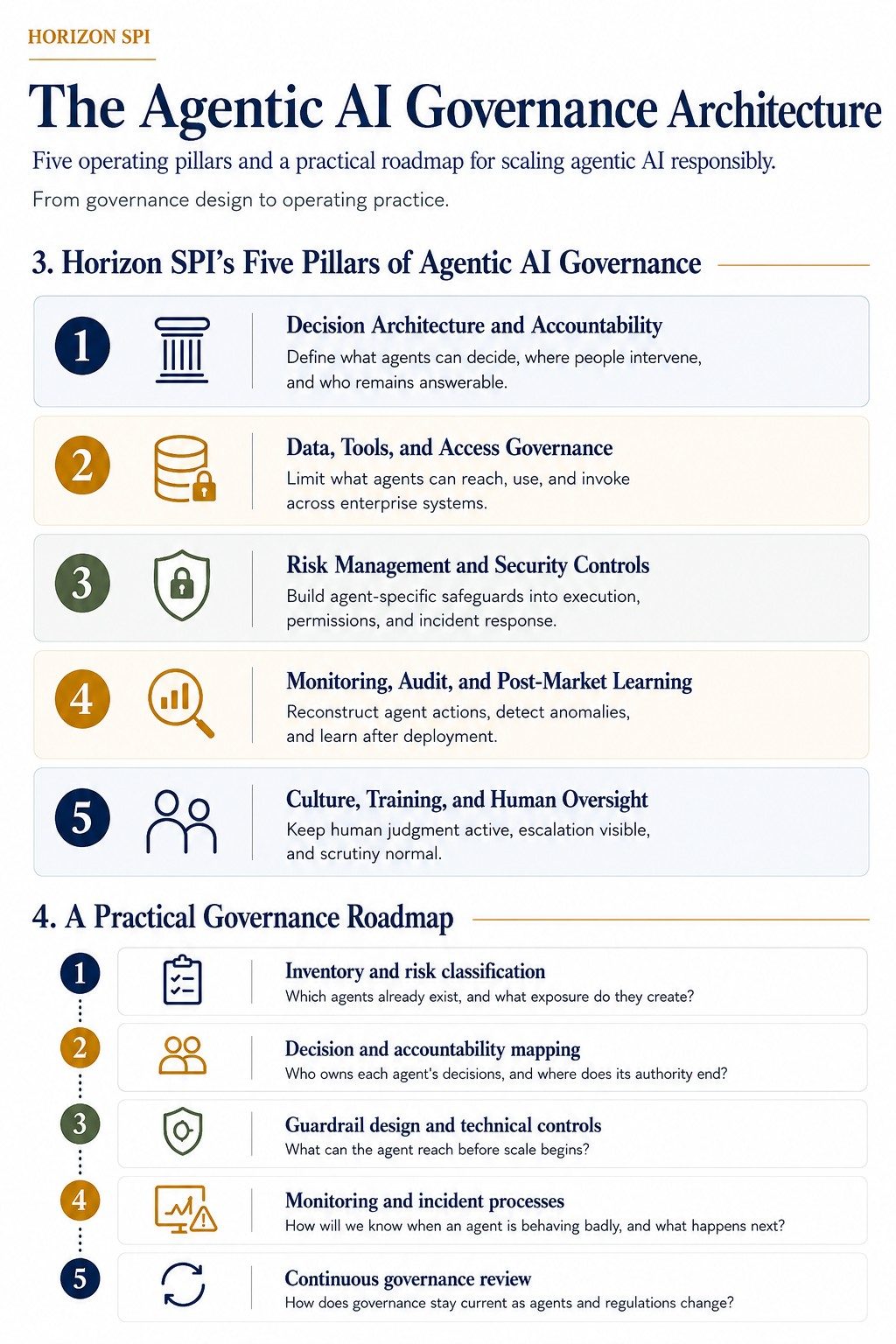
Diagram 2: The Horizon SPI Agentic AI Governance Foundations model brings decision rights, access controls, risk management, monitoring, and human oversight into a practical operating structure.
A Practical Governance Roadmap
For executive teams moving from pilots toward production, the roadmap is easier to use when it is framed through five control questions.
Inventory and risk classification — Which agents already exist, and what exposure do they create?
The first step is to know what already exists. Executives need a clear inventory of current and planned agents, mapped to the business processes they affect and classified against both the EU AI Act and the organisation’s own risk appetite. Without that inventory, governance begins in the dark.
Decision and accountability mapping — Who owns each agent’s decisions, and where does its authority end?
Each agentic workflow should make decision rights, escalation paths, and accountability visible. Leaders need to know where an agent can act alone, where a person must approve, and who remains responsible when the workflow produces a bad outcome.
Guardrail design and technical controls — What can the agent reach before scale begins?
Before a pilot becomes part of the operating model, the organisation needs least-privilege access to tools and data, sandboxed execution where relevant, and security controls aligned with OWASP’s agentic risk categories. Guardrails are much harder to retrofit after the workflow has already scaled.
Monitoring and incident processes — How will we know when an agent is behaving badly, and what happens next?
Monitoring should be designed before production, not added after the first incident. Agents need logging, anomaly detection, and response workflows that connect operational teams with compliance and cybersecurity.
Continuous governance review — How does governance stay current as agents and regulations change?
Governance needs a regular review rhythm. A governance board or similar structure should regularly review agent performance, incidents, user behaviour, regulatory developments, and changes in the operating environment, then adjust policies and architecture when the evidence shows that existing controls are no longer sufficient.
The roadmap does not replace existing AI governance. It extends it into the places where autonomy, tool use, multi-step planning, and direct action change the operating risk.
The Executive Perspective
In 2026, agentic AI is moving from experiment toward infrastructure. Gartner’s projection that up to 40% of enterprise applications will include task-specific agents by year-end points to a rapid change in the software stack. Deloitte’s and McKinsey’s research suggests that meaningful value is possible, but it is still concentrated among organisations that redesign workflows, build clear ownership, and create the foundations needed to scale.
This is the point at which governance stops looking like a compliance workstream and starts looking like an operating capability. It shapes whether agents become a reliable part of the organisation or a source of hidden risk, rising cost, and avoidable failure.
Executive leaders now face a more demanding question than whether to deploy agents. Article 4 showed where early value and early breakdowns are already appearing across financial services, customer operations, supply chain, legal, and software development. The next decision is whether the organisation is building the architecture that sets boundaries, keeps accountability visible, and detects problems before they travel through the business.
Where is agentic AI already moving faster than your governance model, and who owns closing that gap?
Selected References
• Deloitte. The State of AI in the Enterprise — 2026.
• Gartner. Over 40% of Agentic AI Projects Will Be Canceled by End of 2027. Press release, June 2025.
• European Union. Regulation (EU) 2024/1689 — Artificial Intelligence Act.
• European Commission. AI Act implementation timeline and high-risk system rules, updated May 2026.
• Singapore IMDA. Model AI Governance Framework for Agentic AI.
• OWASP. OWASP Top 10 for Agentic Applications.
• McKinsey QuantumBlack. Seizing the agentic AI advantage.
• McKinsey QuantumBlack. The State of AI: Global Survey 2025.
© 2026 Horizon SPI. All rights reserved.
Executive Intelligence Series | horizonspi.com
This article is the fifth in the Horizon SPI Executive Intelligence Series: The Agentic AI Economy. Article 6 will examine the operating model implications of agentic AI, including decision rights, ownership, workflow design, and executive control.