
EXECUTIVE PERSPECTIVES | HORIZON SPI
Governance Becomes Urgent at the Wrong Time
Why Many Organizations Introduce AI Governance After Exposure Already Exists
This article is part of the Horizon SPI Executive Perspectives series on AI strategy, governance, and executive oversight.
AI governance rarely becomes urgent in a boardroom discussion about future strategy.
It becomes urgent after someone has already uploaded sensitive data into an unapproved tool. After a vendor has been selected and onboarded without a formal review. After an AI-generated output has reached a customer without any human oversight requirement in place. Or after leadership sits in a meeting and realizes that no one can clearly explain who owns the organization's AI decisions, what has been approved, or what guardrails actually exist.
I have sat in those meetings. The exposure is already there before the conversation starts. The question is no longer how to prevent it. The question is how much it will cost to manage it.
Governance Is Not a Compliance Problem
The word "governance" carries a lot of baggage. Most leadership teams hear the term and think of legal, IT, or risk committees. That framing is incomplete, and it is part of why governance arrives late.
Governance is the executive decision infrastructure that allows a leadership team to answer at any point: Where is AI being used in this organization? Who is accountable for the outcomes? What are the boundaries? How is performance being measured? And what happens if something goes wrong?
That is what governance protects: capital, accountability, strategic control, and the ability to scale without losing visibility. This is not an abstract ideal. It is a practical operating model for how leadership maintains control as AI becomes embedded in business decisions.
How Adoption Gets Ahead of Oversight
Many organizations do not begin AI adoption through a formal board-level decision. A sales team adopts a productivity tool. A finance lead automates a reporting workflow. A department head implements an AI-enabled process without a formal mandate. Pilots happen. Subscriptions accumulate. Behavior changes before policy catches up.
None of these individual moves looks particularly risky at the moment it happens. That is precisely the problem.
BCG research has found that 60% of companies are failing to achieve material value from AI, reporting minimal revenue and cost gains despite significant investment. ¹ The pattern I keep seeing is not recklessness. It is momentum without a management system behind it. Risk accumulates in the distance between how fast organizations move and how prepared they are to oversee what they have built.
Why Governance That Arrives Late Costs More
Retrofitting governance after AI has already been adopted is not a simple catch-up task. It is a structural and political problem.
By the time leadership decides governance is necessary, teams have already built habits around unapproved tools. Vendor relationships are active. Workflows are embedded. Data has already moved through systems the organization does not control. And the accountability questions that no one answered at the start have now become politically charged because something has already gone wrong, or nearly did.
For small and mid-sized organizations, where leadership capacity is thinner and informal cultures are more entrenched, the cost of unwinding ungoverned AI adoption can quickly exceed what the organization can absorb. The time to build governance is before that cost exists, not after.
Governance Moves Organizations Faster, Not Slower
Many leadership teams still assume governance slows adoption. In practice, early governance usually has the opposite effect.
Organizations that build governance early move faster, not because they have fewer controls, but because they have clearer ones. When use-case approval is defined, employees move forward without hesitation. When accountability is assigned, escalation is clean rather than political. When performance measurement is in place, leadership can decide with confidence whether to scale or stop.
Gartner’s 2025 Market Guide describes AI governance platforms as an emerging market designed to provide central oversight of AI, application of risk management frameworks, and execution of necessary controls.² Gartner also reported that organizations using AI governance platforms are 3.4 times more likely to achieve high effectiveness in AI governance than those that do not.³ That framing matches what I see in practice: governance does not pause innovation. It is the operating system that allows innovation to move at organizational speed rather than individual risk tolerance.
The Horizon SPI Executive AI Governance Framework™
For small and mid-sized organizations, governance does not need to be elaborate. It needs to be proportionate, practical, and specific enough to create accountability before adoption becomes fragmented. The framework below organizes early-stage AI governance around ten decisions every executive team should be able to answer clearly before AI moves beyond experimentation.
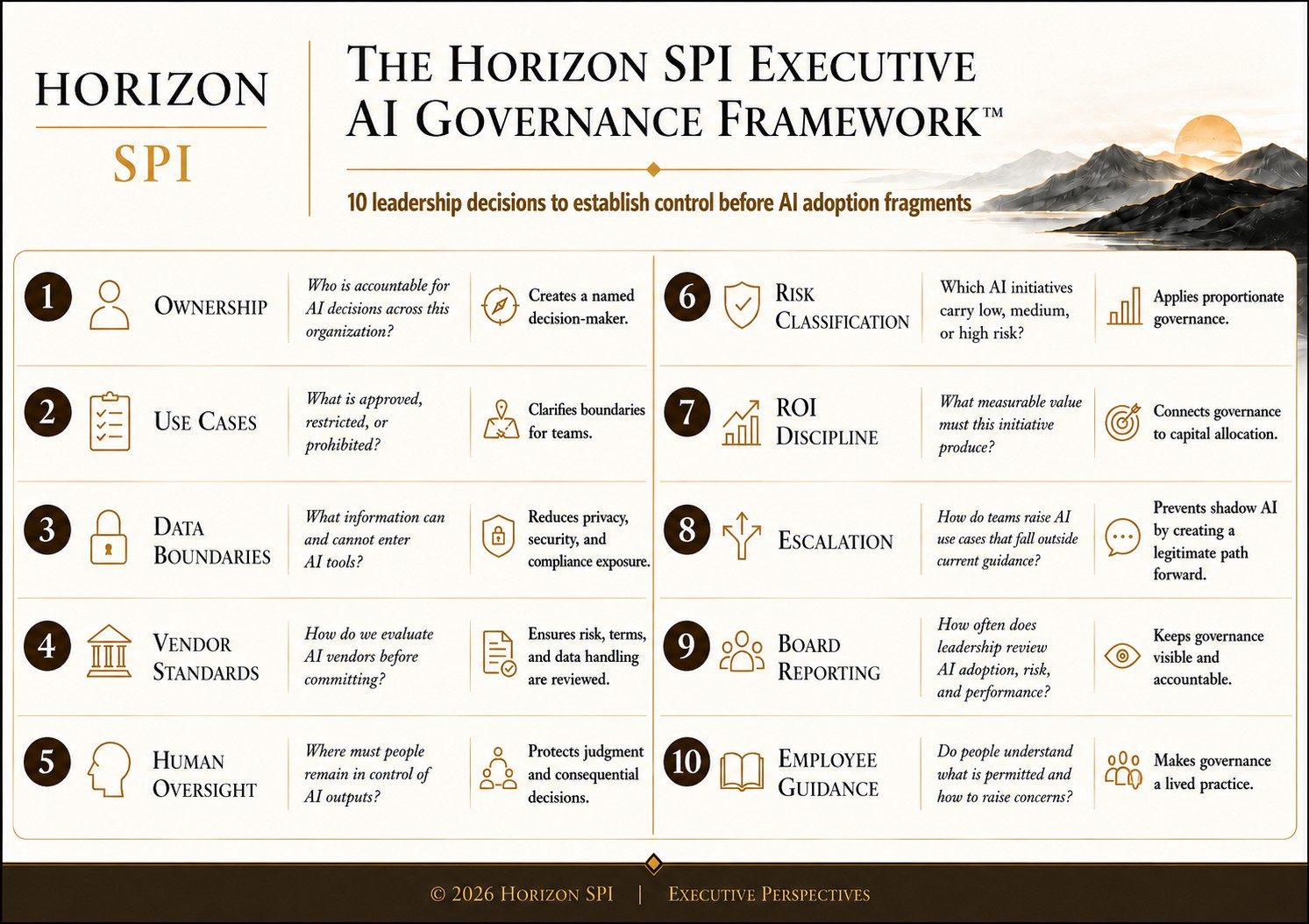
Figure: The Horizon SPI Executive AI Governance Framework
The Real Governance Question
The organizations that lead in AI will not be the ones that build the most governance. They will be the ones that build the right governance at the right time, providing enough structure to move with confidence and enough accountability to protect what they have built.
Governance is not what happens when AI fails. It is what prevents the failure from being expensive. In my experience, leadership teams that understand this distinction before something goes wrong are the ones that remain in control when complexity arises.
_______________________________________________
Selected Research References
1. Boston Consulting Group — The Widening AI Value Gap (September 2025)
https://www.bcg.com/publications/2025/are-you-generating-value-from-ai-the-widening-gap
2. Gartner — Market Guide for AI Governance Platforms (November 2025)
https://www.gartner.com/en/documents/7145930
3. Gartner — Global AI Regulations and AI Governance Platforms Market (February 2026)
Horizon Strategic Partners International advises executive leadership teams on AI strategy, governance, and operating model design. This article is part of the Horizon SPI Executive Perspectives series.
Working With Horizon SPI
Horizon SPI works with executive teams navigating AI governance, oversight, strategic prioritization, and capital allocation decisions.
Organizations evaluating how to establish AI governance before adoption becomes fragmented are invited to request a confidential executive strategy conversation.