
The Architecture of Agentic AI Systems
Inside the machine: how autonomous AI systems are actually built and why it matters for every executive deploying them
The Agentic AI Economy | Article 2 of 8
Horizon SPI Executive Intelligence Series
By Steven Kiss, MBA | June 2026
Executive Summary
Agentic AI systems are not single tools. They are layered architectures that combine reasoning, orchestration, memory, tool access, workflow execution, and governance.
This article explains how those systems are built in practical executive terms. It examines the role of large language models as cognitive engines, the operating cycle that allows agents to perceive, reason, and act, the importance of memory, the role of tool integration, and the emergence of multi-agent orchestration.
The central argument is simple: agentic AI architecture is not only a technical design issue. It is an organizational design issue. Each layer creates decisions about data quality, authority, accountability, escalation, oversight, and control.
For leadership teams, the question is not only whether agentic AI can work. The more important question is whether the organization is structured to deploy, govern, and scale it responsibly.
Every executive who has deployed a generative AI tool has likely encountered the same underlying discomfort: the system produces impressive results, yet very few people inside the organization can clearly explain how those results are actually generated.
A prompt goes in. A response comes out. Somewhere in between, reasoning occurs, but for most organizations, that reasoning process remains largely invisible.
Agentic AI significantly raises the stakes.
Once AI systems begin making multi-step decisions, triggering workflows, using enterprise tools, and interacting autonomously with operational infrastructure, understanding how these systems function stops being a technical curiosity. It becomes an executive responsibility.
Leaders who understand the architecture of agentic systems make better deployment decisions, build stronger governance frameworks, and avoid the category of operational failures that emerge when AI is treated as a black box that can simply be plugged into the enterprise.
This article explains how modern agentic AI systems are actually built in the language of business strategy and organizational design rather than computer science. Each architectural layer presents not just a technical decision, but an organizational one. Where those decisions are made well, agents compound in value over time. Where they are made poorly (or left to default) they compound in risk.
The Brain: LLMs as Cognitive Engines
Most modern enterprise agentic AI systems are built around a Large Language Model (LLM), such as OpenAI's GPT-4o, Anthropic's Claude, or Google's Gemini. But inside an agentic architecture, the LLM plays a larger role than content generation. It becomes the system's decision core.
Every action the system takes depends on a judgment formed at this layer: what the goal requires, which information matters, what the next step should be, and when a situation should escalate rather than continue autonomously. The strategic breakthrough was not scale. It was the emergence of models capable of sustained, multi-step reasoning. OpenAI's release of its o1 reasoning model in late 2024 became a defining signal: LLMs were evolving beyond predictive text engines into systems capable of structured planning and dynamic decision-making.[1]
That distinction carries real organizational consequence. A system that merely responds to prompts creates productivity. A system that reasons — evaluating alternatives, sequencing actions, adapting when circumstances change — begins to create something closer to operational capacity. The LLM does not directly browse the internet, execute workflows, or manipulate enterprise software on its own. What it does is interpret context, formulate decisions, and direct the broader system toward the appropriate actions.[2] Everything else in the architecture serves that cognitive core.
The Operating Cycle: The Perceive-Reason-Act Loop
Architecture describes structure. But what makes agentic AI distinctive is not only its structure. It is its behavior over time. The system that makes this possible is the Perceive-Reason-Act (PRA) loop: the continuous operational cycle through which an agent translates awareness into action, and action into learning.
Where the LLM decides, the PRA loop executes; cycling continuously through four phases until an objective is complete.
Perception begins the cycle. The agent gathers information from documents, databases, APIs, workflow triggers, enterprise systems, or interactions with other agents. This is not passive data ingestion, it is the system actively constructing an understanding of its current operational environment.[4]
Reasoning follows. The LLM analyzes what it has perceived, connects it to the current objective, evaluates possible actions, and determines an appropriate course of action. This is where planning, contextual inference, prioritization, and multi-step reasoning occur. The quality of the underlying model shapes the quality of every downstream decision.
The system then acts: calling an API, updating a database, triggering a workflow, sending a communication, generating code, or delegating a task to another agent. At this stage, reasoning moves from analysis into operational consequence.
Finally, the outcomes feed back into memory and future reasoning. The system adjusts based on results, refining behavior as the cycle repeats. A peer-reviewed architectural analysis published on arXiv in January 2026 supports this description, framing agentic AI as a continuous process that turns perception into action through a central decision-making layer.[3]
This cycle is what separates agentic AI from a chatbot. A chatbot completes a single cycle and stops. An agentic system runs until a goal is achieved, adapting at every step which is precisely why the governance implications are so significant.[5]
The Thinking-Acting Engine: ReAct
Within this operational cycle, one of the most influential architectural approaches in enterprise deployments is known as ReAct — short for Reasoning and Acting. The framework allows agents to alternate continuously between internal reasoning and real-world action, rather than separating the two into isolated stages.
Instead of reasoning fully before acting, the agent produces incremental reasoning steps alongside concrete actions; tool calls, searches, database queries, workflow executions. Each action generates new information, which immediately feeds back into the next reasoning step.[6] This creates a feedback loop between cognition and execution that closely resembles how experienced professionals solve complex operational problems: gathering information, adjusting decisions, and adapting as conditions change rather than executing a predetermined plan.
For executives, the strategic significance of ReAct lies not in its technical elegance but in what it enables organizationally: auditability. When the system is designed to preserve reasoning and action records, organizations can inspect why an agent took a particular action, not only what it did. That capability is a governance prerequisite. Without that visibility, autonomous systems operating across enterprise workflows become difficult to investigate when something goes wrong. With it, they become auditable operational participants.[6]
The Memory Architecture: How Agents Remember
One of the least understood — yet most strategically consequential — components of agentic AI is memory architecture. Unlike traditional generative AI systems that effectively reset between interactions, enterprise-grade agents increasingly operate with persistent memory structures that allow them to retain context, recall prior interactions, and improve performance over time.[7]
This changes the fundamental nature of what is being deployed. An agent that remembers becomes more than a tool responding to prompts. It begins functioning as an operational participant; one capable of accumulating institutional context, carrying continuity across engagements, and learning from the specific conditions of your organization rather than operating from generic training alone.
Enterprise-grade agentic systems operate with four distinct memory functions and understanding each one is an organizational readiness question, not a technical one. Working memory handles the active context of a current task, much like a professional's desk during a complex project: temporary, focused, and cleared when the work is done. Episodic memory retains records of past interactions and decisions giving agents the continuity that prevents them from treating every engagement as if it were the first. In practical terms, an agent without episodic memory may reopen a customer escalation that was resolved the previous week, with full confidence and no awareness of the prior outcome. Semantic memory functions as the system’s knowledge layer: company policy, regulatory requirements, product documentation, and everything the agent needs to act correctly rather than generically. Procedural memory encodes how tasks are performed: the workflows, escalation rules, and execution logic that allow agents to operate consistently across complex recurring processes.[7]
The question executives should be asking is not whether their agentic system has these memory layers. It is whether each layer has been deliberately designed, populated with accurate enterprise data, and governed with the same rigor applied to any other operational system. Agents with weak memory structures lose context, repeat mistakes, and fail to accumulate institutional learning. Agents with well-designed memory improve continuously and increasingly function as long-term organizational assets but that outcome is never accidental. It is the result of design decisions made before deployment begins.[7]
The Hands: Tool Integration and the Enterprise Stack
Reasoning and memory alone do not create enterprise transformation. The real power of agentic AI emerges when cognitive systems connect directly to the operational infrastructure of the organization itself.[2]
This is what separates agentic AI from earlier generations of intelligent software. The system is no longer confined to generating recommendations or assisting users inside isolated interfaces, it is increasingly interacting directly with the tools, platforms, workflows, and systems that run the enterprise.
APIs provide the primary integration layer. But the strategic implication goes beyond connectivity: when agents can read from and write to enterprise systems such as ERP platforms, CRM databases, financial systems, HR software, they stop being advisory tools and become operational participants with the ability to change the state of the organization. That shift in capability requires a corresponding shift in governance thinking.[2]
The Model Context Protocol (MCP), an emerging standard championed by Anthropic and increasingly supported across the AI ecosystem, is designed to simplify how agents connect to external tools, services, and enterprise data sources. Rather than requiring custom integrations for every individual system, MCP creates a standardized communication layer across the enterprise environment.[3] Its significance is architectural: organizations that build on MCP preserve optionality as the vendor landscape evolves, rather than embedding deep dependencies into proprietary integration layers.
One of the most consequential capabilities is native computer use: systems able to interact directly with software applications through keyboard, mouse, browser, and interface controls in much the same way a human operator would. OpenAI's Computer-Using Agent (CUA) and similar architectures allow agents to navigate enterprise software environments even when no API exists.[3] This dramatically expands the range of systems agents can operate across, including legacy applications never originally designed for AI integration which, in most large enterprises, represents the majority of the technology estate.
The Team: Multi-Agent Orchestration
Even highly capable individual agents have practical limits. Complex enterprise operations — spanning multiple systems, specialized domains, and parallel streams of work — exceed what any single agent can reliably manage alone.[8]
The emerging response is multi-agent orchestration: coordinated networks of specialized agents operating together inside a larger execution architecture. The dominant pattern is the Orchestrator-Subagent model, in which a coordinating agent receives a high-level goal, decomposes it into subtasks, delegates each to a specialist agent, monitors progress, and synthesizes results into a final output. Specialist agents operate in parallel, one handling data retrieval, another analysis, another report generation, another stakeholder communication, each working within its defined domain while the orchestrator maintains coherence across the whole.[8]
This architecture can compress the time required for complex tasks and improve output quality where work needs to be divided across specialized roles.[6] Industry analysis describes this pattern as enabling dynamic task allocation, specialized role assignment, and collaborative synthesis across enterprise workflows.[8]
The organizational implication is significant. Deploying agentic AI at scale is not only a technology implementation. It is also an organizational design challenge. Decisions about agent roles, authority boundaries, escalation pathways, and communication protocols are governance decisions as much as architectural ones and they need to be made with the same deliberateness as any organizational structure decision.
The Horizon SPI Agentic Enterprise Stack™
The architectural components described in this article do not operate independently. They are interdependent layers in a unified system, and the strategic and governance decisions governing each layer determine whether the system as a whole creates compounding organizational value or compounding organizational risk.
The Horizon SPI Agentic Enterprise Stack™ maps these components into a single integrated framework, designed not as a technical reference diagram but as an executive decision-making tool. Each of the six layers represents a domain where organizational choices matter. The cross-cutting governance principles on the right side of the framework reflect a central Horizon SPI position: governance is not a layer to be added after the system is built. It is the connective architecture that runs through every layer, connecting governance and oversight with data, knowledge, reasoning, orchestration, integration, memory, and learning.
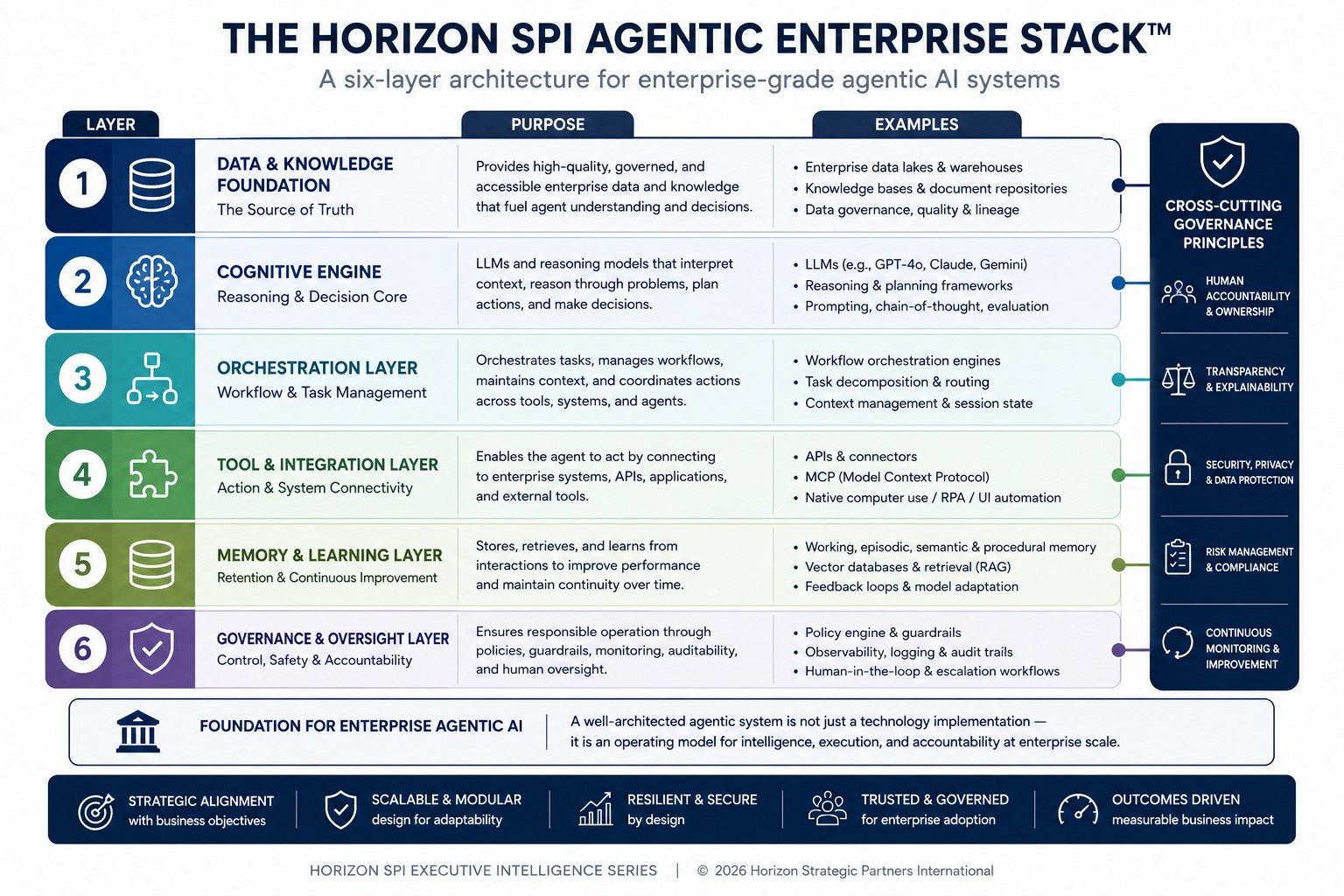
Diagram 1: The Horizon SPI Agentic Enterprise Stack™ shows the architectural layers and governance principles needed for enterprise-grade agentic AI deployment.
Reading the framework from the top to bottom: Layer 1, the Data and Knowledge Foundation, is where agent quality originates, the source of truth on which every downstream decision depends. Layer 2, the Cognitive Engine, houses the LLM reasoning core. Layer 3, the Orchestration Layer, manages workflow decomposition and task routing. Layer 4, the Tool and Integration Layer, connects the agent to enterprise systems via APIs, MCP, and native computer use. Layer 5, the Memory and Learning Layer, determines whether the system retains institutional knowledge across deployments. And Layer 6, the Governance and Oversight Layer, provides the policy engine, audit infrastructure, and human escalation mechanisms that make the system accountable.
Each layer has a corresponding set of organizational decisions. Organizations that assess their current agentic readiness through this framework will typically find that Layers 1 through 3 are partially in place, Layer 4 is being addressed, and Layers 5 and 6 are either still immature or missing altogether. The gap between where many organizations are today and where enterprise-grade agentic deployment requires them to be is often a governance gap before it is a technology gap.
Organizations that attempt to retrofit governance after autonomous systems are already operating across the enterprise will typically encounter greater operational, compliance, and organizational complexity than those that embedded it from the start.
What Executives Need to Understand
For executive leadership teams, the architecture of agentic AI is not a technical abstraction. It is increasingly the operational logic of systems that will participate directly in enterprise decisions, workflows, and outcomes. Three realities deserve particular attention.
First, data quality directly determines agent quality. Autonomous systems operating on fragmented, poorly governed, or inconsistent enterprise data will generate unreliable outcomes often with confidence and at scale. As organizations move toward agentic infrastructure, investment in data architecture becomes a strategic prerequisite rather than a back-office IT concern.[1]
Second, memory architecture determines whether agents evolve into compounding organizational assets or remain isolated productivity tools. Systems capable of retaining context, learning from prior interactions, and accumulating institutional knowledge become progressively more valuable over time. That outcome is not accidental; it is the result of architectural design decisions made well before deployment.[7]
Third, governance must be embedded directly into the architecture. Frameworks such as ReAct create explicit reasoning traces that make agent behavior observable and auditable but only if organizations intentionally design for oversight, logging, escalation controls, and intervention mechanisms from the beginning.[6][3]
Organizations that build observability and governance into the architecture early will retain significantly greater operational control than those that attempt to impose governance after autonomous systems are already deeply integrated into enterprise workflows.
As enterprise systems become increasingly autonomous, architecture itself becomes a strategic leadership issue. Executives who understand how agentic systems are structured will make better decisions about deployment, governance, accountability, and long-term organizational design.
______________________________________________________________________________________________________________
Selected References
[1] Unstructured.io. (2025, June 6). Agentic AI architecture: Defining the autonomous enterprise. https://unstructured.io/blog/defining-the-autonomous-enterprise-reasoning-memory-and-the-core-capabilities-of-agentic-ai
[2] AWS. (2025). Generative AI agents: Replacing symbolic logic with LLMs. https://docs.aws.amazon.com/prescriptive-guidance/latest/agentic-ai-foundations/generative-ai-agents.html
[3] arXiv. (2026, January 17). Agentic artificial intelligence: Architectures, taxonomies, and evaluation of large language model agents. https://arxiv.org/abs/2601.12560
[4] TestGrid. (2026, February 13). Inside agentic AI: How machines learn to perceive, reason, and act. https://testgrid.io/blog/what-is-agentic-ai/
[5] Kore.ai. (2025, September 21). What is agentic AI? A comprehensive guide 2026. https://www.kore.ai/blog/what-is-agentic-ai
[6] Eudoxus Press. (2025). Multi-agent architecture for enterprise AI orchestration. https://eudoxuspress.com/index.php/pub/article/download/4108/2992/8175
[7] Algomox. (2025). Memory in agentic AI: How to build long-term IT knowledge. https://www.algomox.com/resources/blog/agentic_ai_memory_it_knowledge
[8] Anthropic. (2024, December 18). Building effective agents. https://www.anthropic.com/research/building-effective-agents
© 2026 Horizon SPI. All rights reserved.
Executive Intelligence Series | horizonspi.com
This article is the second in the Horizon SPI Executive Intelligence Series: The Agentic AI Economy. Article 3 will examine the companies actively building the agentic economy, including Microsoft, OpenAI, Google, Anthropic, Amazon, and Salesforce, and will map their competing strategic approaches.